
Chairside 22
Crown or Restoration? The Challenge of an Anterior Tooth with Extensive Internal Destruction
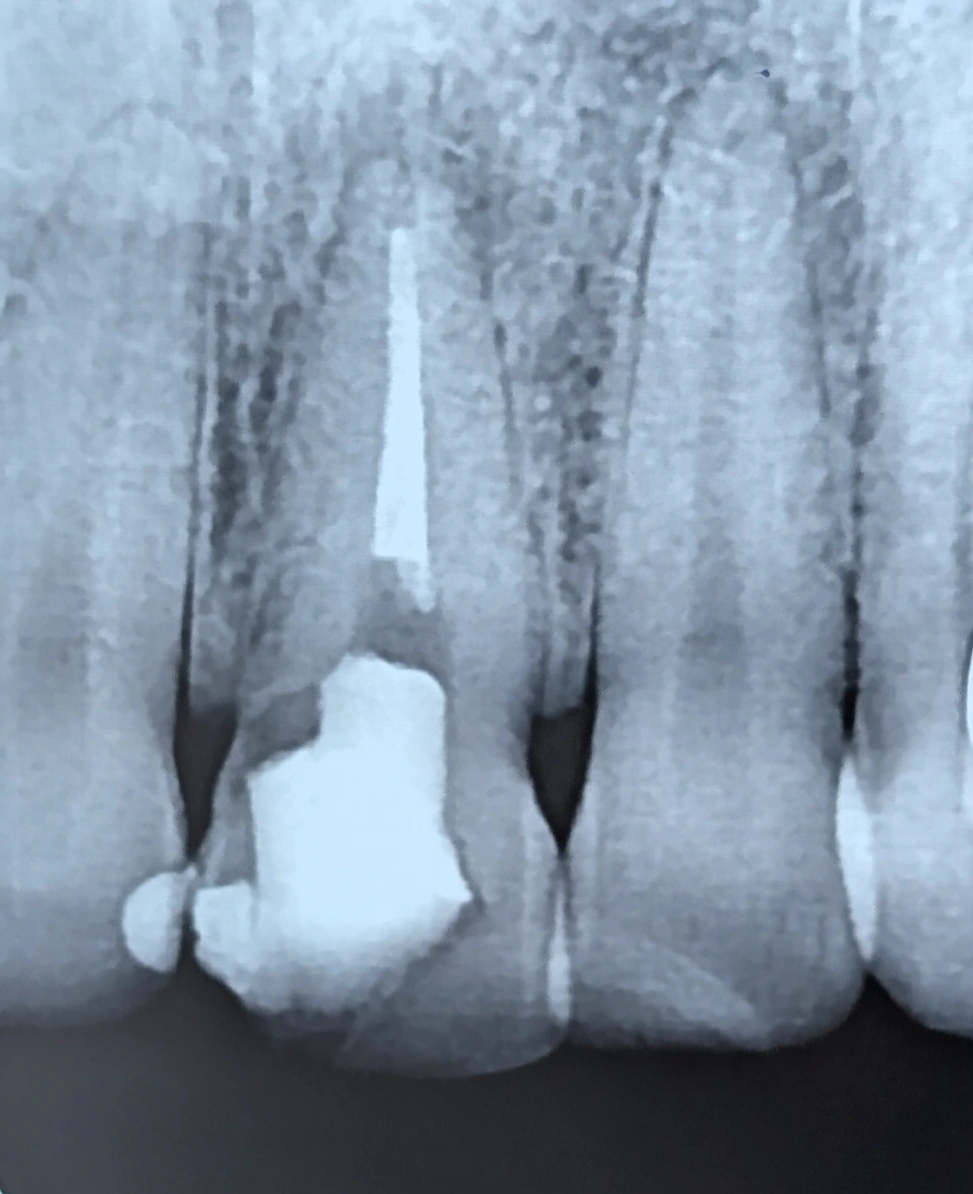
The patient came in for the central incisor. It had a large composite restoration whose shape and color were both unsatisfactory. She said the tooth had already been restored with composite multiple times, but she was still never happy with it, and she was now asking for a crown for esthetic reasons.
I took a periapical radiograph. It showed extensive internal destruction, and the mesial wall was very thin.
I explained to her that the tooth had extensive destruction from within, and that preparing it for a crown would also require reducing it from the outside. In that case, the same thin wall that was still holding on would be lost as well. In other words, under these conditions a crown would shorten the tooth's lifespan rather than extend it. Contrary to what the patient assumed — that a crown was the way to save the tooth — here the crown itself would be the source of weakening.
I told her to pursue a restoration instead of a crown. She said she had already had many restorations done and was still unhappy. I explained that the problem wasn't restoration as an option in itself, but whether it was carried out correctly. I referred her to a restorative specialist so that a properly executed adhesive restoration could be done for her.
The reasoning behind this decision went as follows:
- Weighing the patient's request (an esthetic crown) against the tooth's actual condition.
- Reviewing the radiograph: extensive internal destruction and a very thin mesial wall.
- Assessing the consequence of a crown: the need for external reduction and the loss of the last remaining wall — i.e., a shortened tooth lifespan.
- Deciding to refer the patient for a properly executed adhesive restoration instead of a crown.
️Sometimes what the patient is asking for (a crown for esthetics) is exactly what would harm the tooth the most.
️Dissatisfaction with previous restorations doesn't mean restoration was the wrong option; sometimes the problem was in the execution, not in the treatment choice.
The content of this page is intended for the educational use of dentists and dental students.