
Chairside 23
Implant Abutment Fracture After 9 Years: When Jaw Biomechanics Fall Victim to Missing Teeth
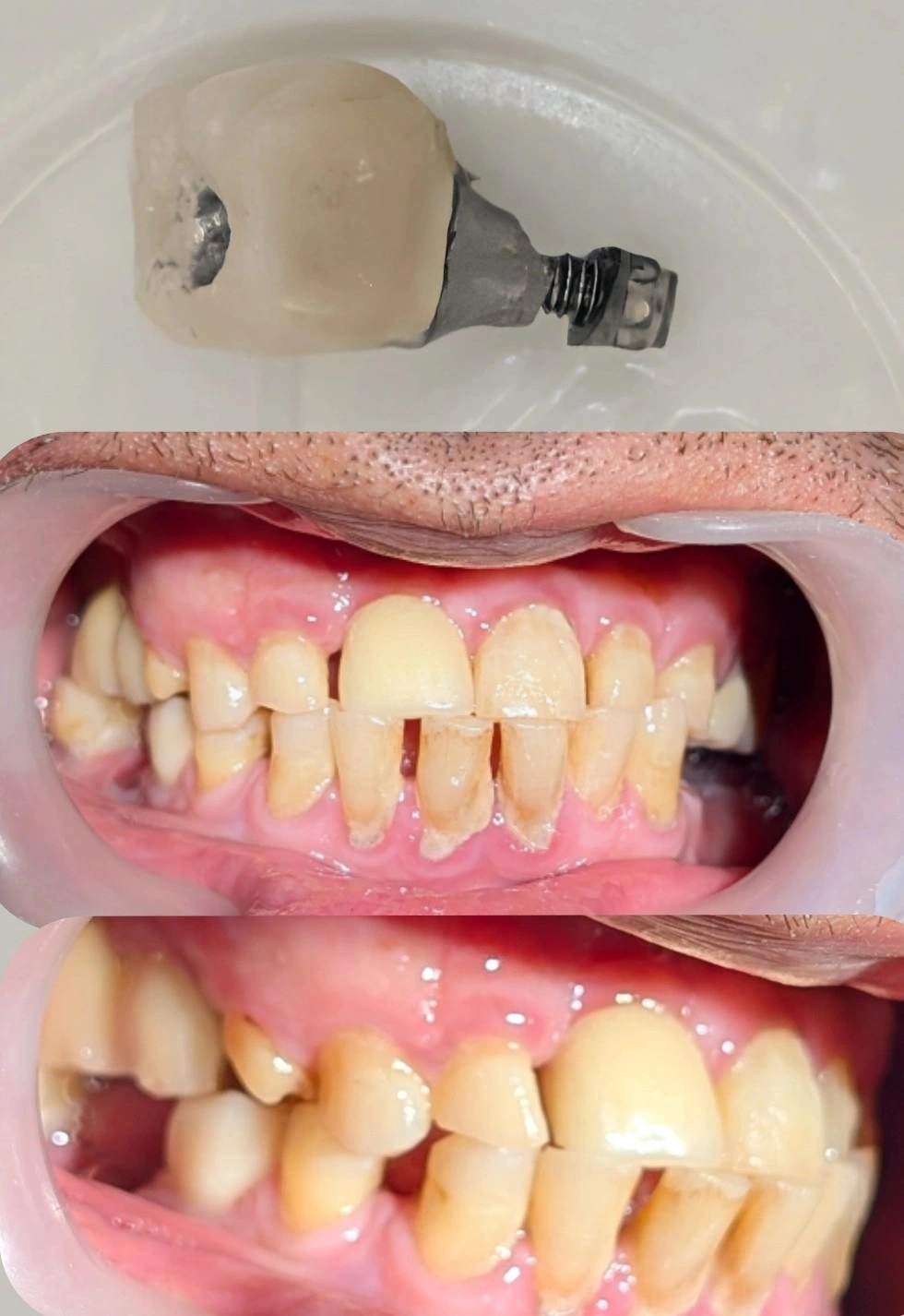
A patient of mine returned nine years after I had placed an implant and crown on their lower right tooth #6. This time the complaint was a loose crown. The first notable detail was that the patient had recently had an implant and crown placed on tooth #5 on the same side, at a different clinic, and assumed the looseness was related to that new tooth #5. Examination showed the source of the looseness was actually tooth #6 — the old implant — not tooth #5.
The standard plan was clear: create an access hole through the crown, reach the abutment screw, remove the loosened screw, replace it with a new one, and re-deliver the crown. I proceeded exactly along that plan, but after removing the restoration I was met with an unexpected finding. The screw hadn't simply loosened — the abutment itself had fractured. The severity of the damage was clearly visible in the photo of the removed piece.
To find the root cause, I examined the whole mouth as one integrated system. The following factors came together in this order:
- Parafunctional forces and severe wear. All of the patient's teeth show obvious attrition, meaning the dentition was predisposed to heavy, damaging occlusal forces from the outset.
- Loss of the opposing teeth. The patient had lost the lower left teeth about 2 to 3 years earlier and never replaced them; as a result, chewing load had unconsciously shifted to the right side.
- Ineffective engagement of the new implant (tooth #5). The crown recently delivered by another colleague had no active, effective contact with the opposing teeth.
- Force concentration on tooth #6. Across the entire right side, apart from the crown on tooth #6, only tooth #7 had any contact — and even that was weak, limited to about half the tooth's surface.
The biomechanical result was that heavy jaw forces, instead of being distributed across the whole arch, were concentrated on tooth #6. First the screw loosened; the patient chewed on the loose crown for a while; and eventually the stress reached the point where the abutment's metal structure fractured.
The next steps in treatment are as follows:
- A thorough evaluation of the fixture — confirming the fracture did not damage the fixture's internal threads and that osseointegration remains sound.
- Correcting the occlusion and biomechanics — the worn upper right tooth needs to be brought back into proper occlusal contact to redistribute the load; otherwise, simply replacing the abutment and fabricating a new crown will only repeat the same failure.
- Comprehensive treatment — the patient should have the long-empty left side implanted at the earliest opportunity to restore chewing balance across the whole mouth.
️The mouth is a dynamic system; losing teeth or poorly executed restorations on the opposite side worsen the biomechanical situation and make the breakdown progressive.
️An annual implant checkup isn't a formality; skipping it can turn a simple screw loosening — fixable with a single tightening — into a structural fracture and a complex treatment.
The content of this page is intended for the educational use of dentists and dental students.