
Chairside 31
A Tooth Without Function Is Merely Occupied Space
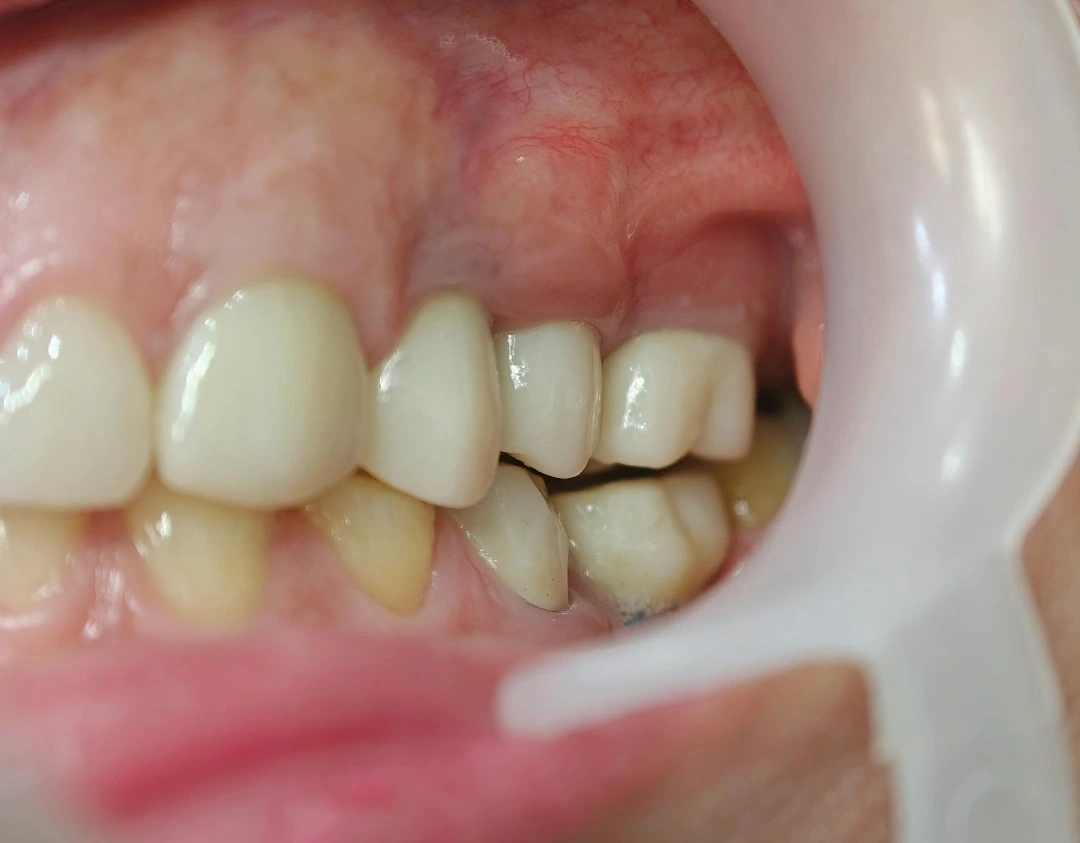
The patient came in for a gingival ulcer, but what this visit called for was not treating the ulcer; it was finding the reason that pushed her to move the bolus to a side where nothing stands opposite.
Presenting Complaint. The patient presented with a recurrent ulcer in the gingiva distal to the upper right first molar. On clinical examination, an ulcer was evident on the maxillary gingiva directly opposing the lower second molar. The patient had implant crowns in the lower second premolar and first molar sites.
Evaluation. The implant crowns on the lower second premolar and first molar had been made markedly short and sit in infra-occlusion. As a result, the patient effectively cannot chew in this region and, to compensate, unconsciously directs the food bolus posteriorly, to the second molar area. Chewing food between the lower second molar and the edentulous maxillary gingiva has produced continuous tissue trauma and the resulting ulcer.
On the other hand, the lower second molar, having lost its antagonist, has undergone supra-eruption and has entirely eliminated the maxillary restorative space. Because the intact upper second molar site was seen as "too good to touch", the previous colleague declined to reduce and shorten the tooth to create space; consequently, the upper second molar site has been left with neither an implant nor an opposing tooth.
Decision and Treatment Plan. A tooth that has no function and takes no part in occlusion has no use in the masticatory system, regardless of how intact its crown is. Leaving this tooth as it stands does not help the patient — it is the principal cause of the soft-tissue trauma.
The corrective treatment plan comprises the following stages:
- Restoring function further forward: replacing the implant crowns on the lower second premolar and first molar with new crowns of adequate occlusal height, so that the patient can complete the chewing cycle in that region and stop shifting food posteriorly.
- Reclaiming the restorative space: preparing the lower second molar — reducing and shortening the crown (with elective root canal treatment if required) — to the extent needed to provide sufficient restorative space for the maxilla.
- Completing the occlusion: placing an implant in the upper second molar site and fabricating a crown to establish correct occlusal contact with the lower second molar, restoring function.
️Clinical Tip: the biomechanical value of a tooth does not lie in it being untouched, but in the role it plays within the masticatory system. A tooth with no antagonist, carrying no occlusion and occupying the prosthetic space of the opposing arch, must be corrected to restore the whole system — even when that correction costs an extensive reduction or the root canal treatment of a vital tooth. A tooth without function is, in practice, of no use.
The content of this page is intended for the educational use of dentists and dental students.