
Chairside 34
Can We Actually Improve the Patient’s Chief Complaint?
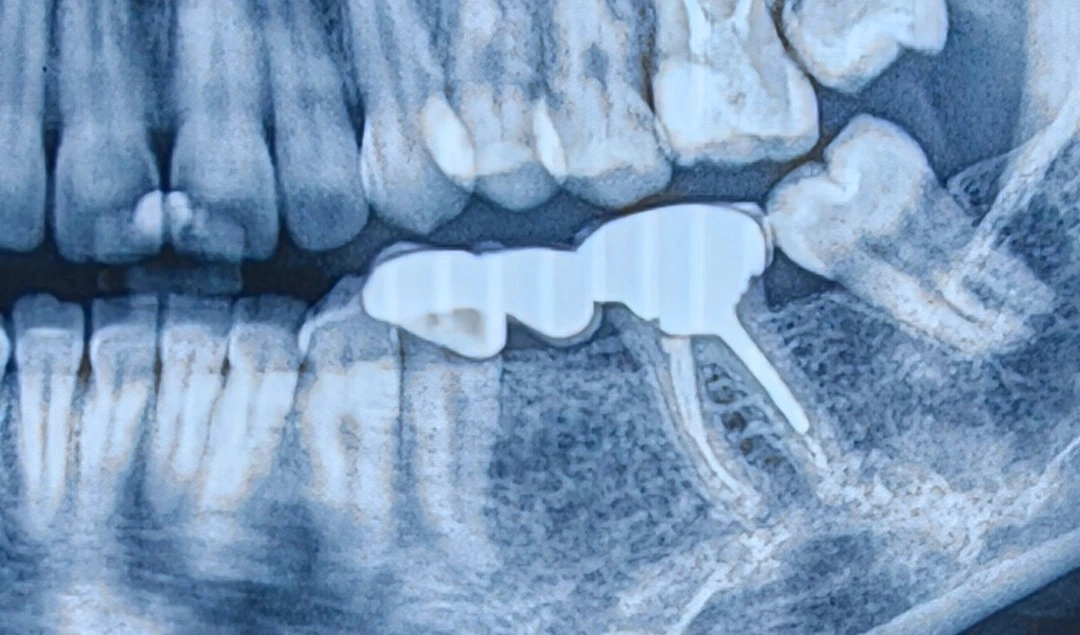
The newly delivered bridge is anatomically and esthetically poor— a flattened occlusal surface, opaque porcelain showing through, even metal is visible. But the patient complains of none of that; the sensation is that the tongue side is bulky. The work of this visit, before the turbine, is to see whether this complaint would be resolved by replacing the bridge at all.
The patient presented with severe dissatisfaction with a recently delivered bridge. Even though the occlusal surface of the prosthesis has been completely flattened by repeated grinding, the opaque is showing through and even metal is visible in places, and it lacks proper esthetics and anatomy, the chief complaint is something else: the patient feels the prosthesis occupies too much of the mouth and the tongue side is prominent. The main challenge of this visit is that, before reaching for the turbine, we see whether the patient’s subjective complaint would actually be resolved by retreatment.
Presenting Complaint. The patient presented complaining that “I just had this bridge placed, I am not satisfied at all, and it feels like too much in my mouth.” At first glance the bridge is technically and visually very poor; it has no occlusal anatomy, the occlusal surface is opaque from excessive grinding, metal is showing through in places and even visible in others. But the patient has no complaint about appearance, esthetics, chewing, or food trapping; the entire focus is the sensation of bulk on the lingual side.
Clinical Evaluation and Decision-Making.
- Lingual contour: on careful intraoral examination, the lingual surface of the bridge has no unusual prominence relative to the other teeth in the arch, and its contour is entirely within the normal range.
- Radiographic assessment: on the panoramic view, no gross technical seating error is seen, although a periapical radiograph must be reviewed for a final judgment on possible caries or the margins of the anterior abutment.
- Matching the complaint to what treatment can do: esthetics is a subjective issue, but tooth contour and position are an objective biomechanical fact. If the patient’s problem were food trapping, a high bite, or esthetics, replacing the bridge would certainly improve the result; but when the lingual contour is within normal limits, even a perfect, beautiful bridge still cannot occupy less space on the tongue side, and the patient’s sensation after retreatment would be exactly as it is now.
Treatment Plan and Response to the Patient. Immediate start of prosthesis replacement was declined.
The patient was told:
“The present bridge is not esthetically attractive and does not have good anatomy, but that is not what you are dissatisfied with. The point is that the tongue-side form of this bridge is entirely normal, and if I remove this work and make you the most beautiful, most delicate bridge in the world, I still cannot make the tongue side any less bulky than this. You would spend money, you would make the trips, and in the end you would have the same heavy sensation as before.”
Treatment was not stopped but conditioned: the patient was told to obtain a periapical radiograph first so that if the abutments had a serious biologic or technical problem (such as open margins or caries) the right decision could be made; otherwise replacing the prosthesis would not help resolve the subjective complaint.
️Clinical Tip: in consultation visits, before any action, we must weigh whether we actually have the ability to resolve the patient’s “chief complaint”. If the problem the patient raises cannot be changed within anatomic standards, replacing an unattractive prosthesis merely makes you a partner to an unresolved dissatisfaction.
The content of this page is intended for the educational use of dentists and dental students.