
Chairside 35
Bleaching Before Laminates: A Smart Strategy for Less Preparation
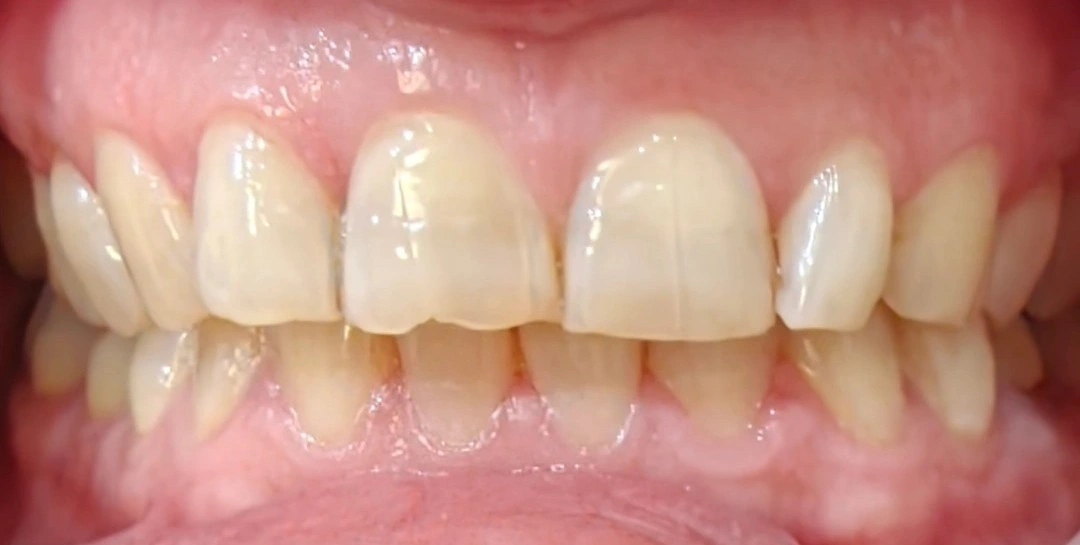
The anteriors are yellow and their form does not satisfy the patient either. Laminates would cover both, but a dark stump shade means thicker ceramic and deeper enamel reduction. The work of this visit is to see, before the turbine, whether a lower-prep path exists.
The patient presented dissatisfied with the yellow color and the form of the teeth. The quick, routine approach in these cases may be to prepare immediately for laminates; but there is a biomechanical challenge: masking a dark abutment shade needs more ceramic thickness and therefore deeper enamel reduction. The work of this visit is to find a more conservative path before reaching for the turbine.
Presenting Complaint. The patient presented complaining of yellow teeth and also of their unsuitable form, and asked for a smile correction. The routine solution is to prepare the teeth for laminates, correct the forms, and plan a light shade for the ceramic. But the main concern was how much healthy tooth tissue would be preserved.
Clinical Evaluation and Decision-Making.
- Stump-shade challenge: the color of the underlying tooth (the substrate) always affects the final laminate result. Depending on which cement we use, that effect can be smaller or larger, but it is always present and always matters.
- The cost of a large shade change: the yellower the abutment and the lighter the shade the patient wants, the more we have to reduce the tooth to make enough space to block out this dark color. That means losing valuable enamel.
Treatment Plan and Our Approach. Immediate start of laminate preparation was declined, and a preparatory phase was prescribed instead:
I explained to the patient that before any other step they should complete a course of bleaching. That leaves two scenarios:
- First scenario (ideal): with whatever probability, if bleaching works and the teeth become light enough that the patient is fully satisfied with their appearance and color, a laminate may not be needed at all.
- Second scenario (conservative): if because of particular shade conditions or the patient’s insistence on changing tooth form we still need a laminate, this initial bleaching is a large gain for us. Because the abutment shade is lighter, the underlying shadow has less effect on the final laminate, and we can reach the desired shade with the least possible preparation.
️Clinical Tip: in cases where the patient needs a large shade change in addition to solving other problems, always think of bleaching before you prepare. Lightening the abutment tooth — the stump shade — is the main key to reducing the ceramic thickness required and keeping the preparation conservative. Conservative preparation and an enamel substrate also increase the restoration’s longevity
The content of this page is intended for the educational use of dentists and dental students.