
Chairside 51
A bridge without effective contacts
A patient came in for a visit and said they were not happy with a bridge that had been placed for them some time ago. They said they could not chew food properly with this bridge and swallowed most food more or less whole. They had told their dentist as well, but had been told that nothing else could be done and that they had to get used to the bridge.
I placed 20-micron articulating paper and asked the patient to bring their teeth together. Contacts registered only on tooth 5. Tooth 4 had no contact at all, and tooth 6 had contact only on a small part of one of its cusps. In other words, the patient was effectively eating on a single point, and it is natural for them to feel that the bridge "doesn't work".
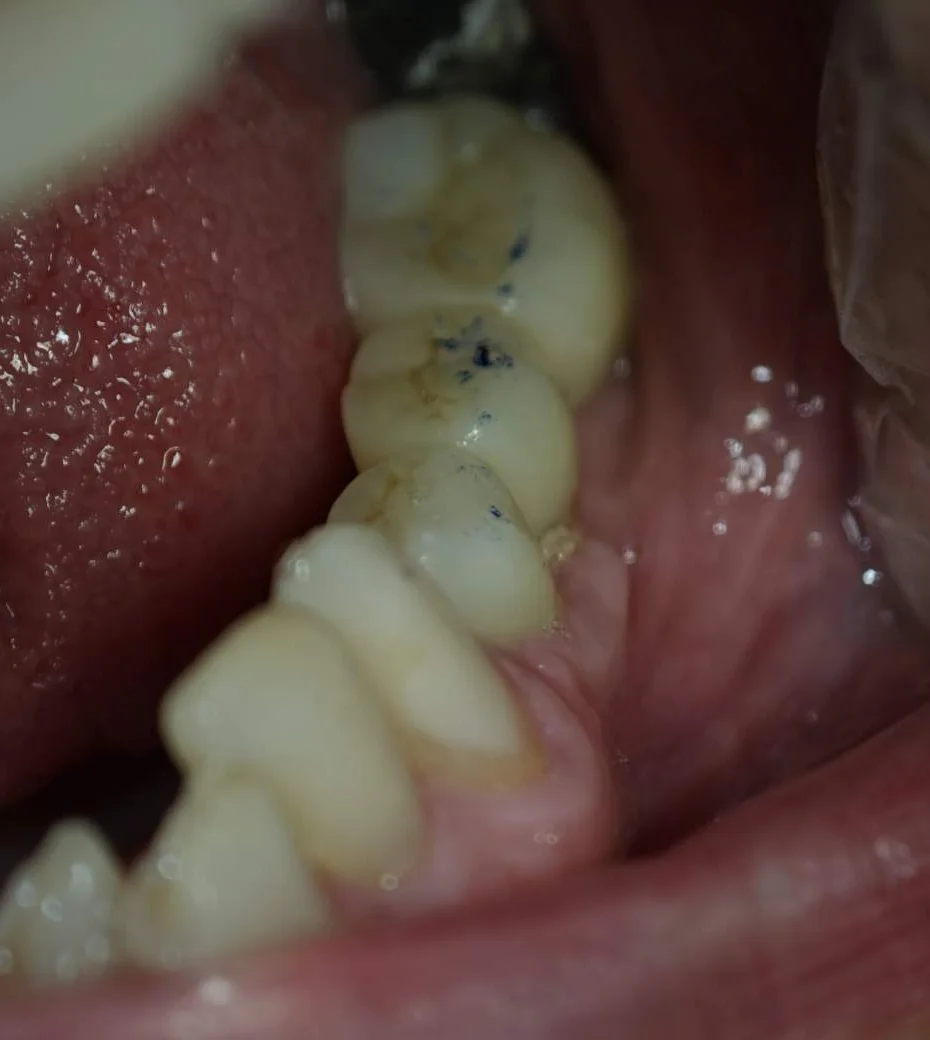
In my view, what happens here is very common. We place the paper, the patient bites, the paper holds, and we assume the occlusion is right. But the paper holding only shows that there is a contact somewhere. It does not tell us which tooth that contact is on, which cusp and fossa, or how much force it carries.
There is one more point. Some people think that wherever the paper leaves a mark, that spot is high and should be ground down. A paper mark only shows that there is contact there, not that it is high. In a correct occlusion, marks should appear on all the teeth. Whether something is high has to be judged by looking at the other teeth: if the others have contact too and only one unit of the bridge is out of contact, the problem is that this unit is short, not that the spot where the mark appeared is high.
The patient's ability to chew has nothing to do with our paper holding. We need to see whether the contacts are spread across all the units, sit in the right place, and have appropriate intensity. Occlusion means the quality and distribution of contacts, not merely the presence of one contact.
This page is intended for educational use by dentists and dental students.