
Chairside 55
Bone Loss and an Apical Lesion Beneath Splinted Crowns: A Clinical Case and Retreatment Plan
∆ 1. History and the patient's account
The patient presented initially with a complaint of gum discomfort and said that, after a visit to a periodontist, they had been told: “The gums are healthy and the problem is probably the teeth under the crowns.” Given the radiographic appearance, that sentence was probably passed on incompletely, or the patient did not fully grasp the colleague's explanation, because the radiograph shows the source of the problems clearly.
∆ 2. Radiographic findings: why the splinted crowns caused trouble
On the radiograph, two posterior mandibular molar crowns are splinted together and have overhanging margins. This inadequate prosthetic design created several problems at once:
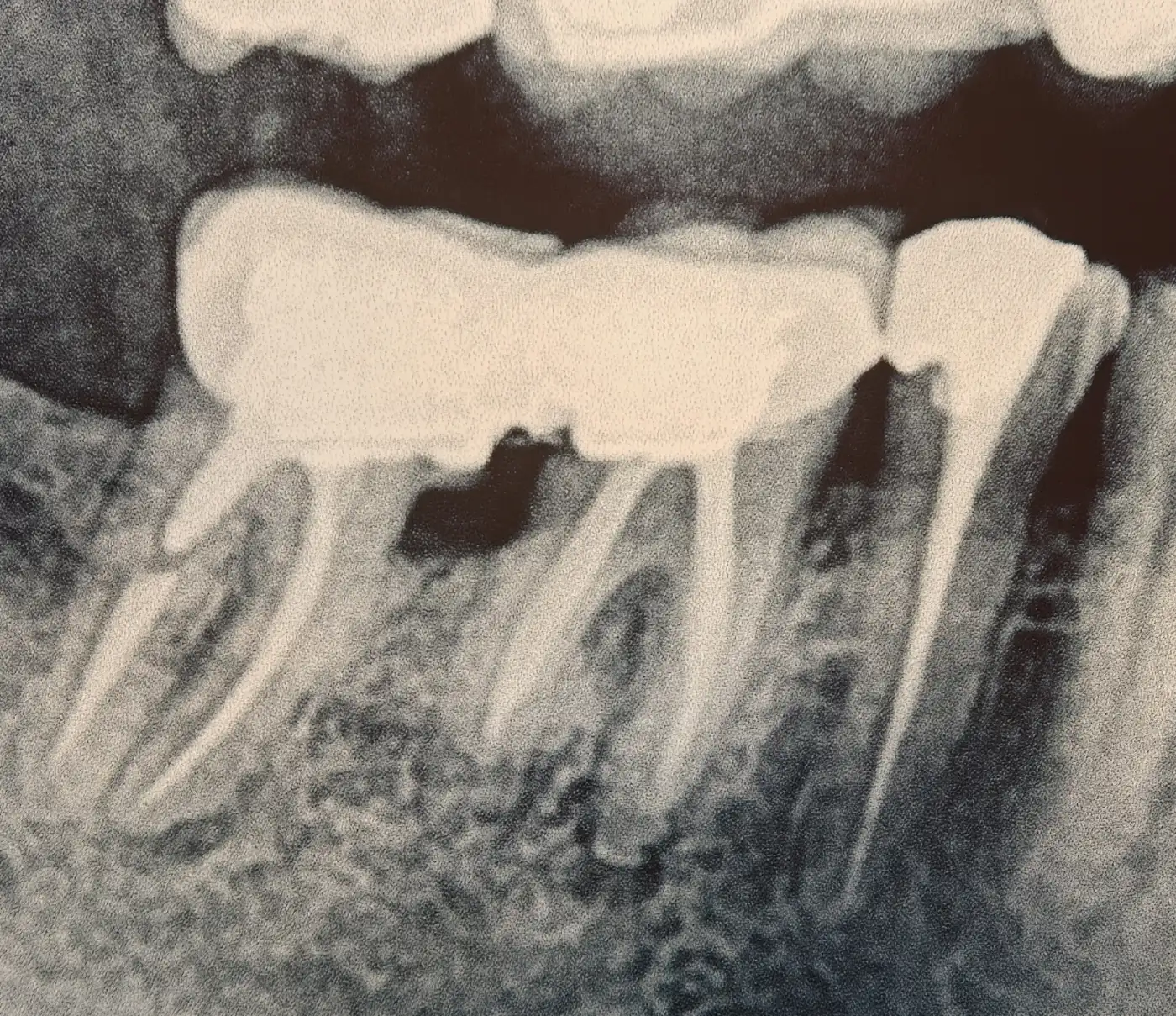
- Food impaction and interdental bone loss: the splinted crowns and the overhang block floss passage and interdental hygiene, and the constant food trap has driven interdental bone loss.
- Incomplete root canal treatment and an apical lesion: apically, the canals are incompletely filled and a periapical lesion is clearly visible, requiring endodontic retreatment.
∆ 3. Step-by-step treatment plan
To correct the periodontal situation and restore adequate function, treatment was planned in the following stages:
- Remove the splinted crowns and assess the remaining tissue: the splinted crowns are removed first so that, after any caries is cleaned out, the amount of sound structure remaining can be assessed and the prognosis of each tooth defined precisely.
- Endodontic retreatment (re-endo): if the teeth are restorable, retreatment takes priority, because the previous root canal treatment is incomplete and an apical lesion is present.
- Rebuild the crown and deliver separate crowns: once endodontic treatment succeeds, the crown is rebuilt (with a post and core if needed) and the crowns are finally delivered as single units with standard contours, so that interdental hygiene is easy to maintain and the gingiva stays healthy.
This page is intended for educational use by dentists and dental students.