
Insight 120 — A Debonded Lateral Incisor Laminate: Should You Worry About Root Canal Treatment?
A patient with a history of ceramic laminate treatment at another clinic presented for consultation. The laminate on the upper lateral incisor (#12) had debonded, and the patient reported mild sensitivity in that tooth.
He had previously been referred to an endodontist for pulp evaluation and then to a prosthodontist for consultation. Although no detailed record of the earlier conversation was available, his repeated questions about the meaning of “necrosis” suggested that prophylactic root canal treatment, or concern about future necrosis, had probably been raised with him. During the visit he kept asking about the likelihood of needing root canal treatment, about the tooth becoming weaker after it, and about whether the laminate could be kept or remade.
His concern was not limited to the current situation; he wanted to know what would happen to the laminate if it were remade and the tooth later became necrotic or required root canal treatment, and whether the treatment would end in a full crown. He was even worried about problems developing in the laminate itself and their consequences. His central worry was uncertainty about the durability of the laminate in the long term, should the pulp status or the condition of the restoration change.
∆ 1. Assessing the tooth
On examination, the patient had no spontaneous or continuous pain, and the current mild sensitivity could be attributed to exposure of the prepared tooth surface after the laminate debonded. The remaining healthy tissue was in good condition, and nothing prevented rebonding the laminate.
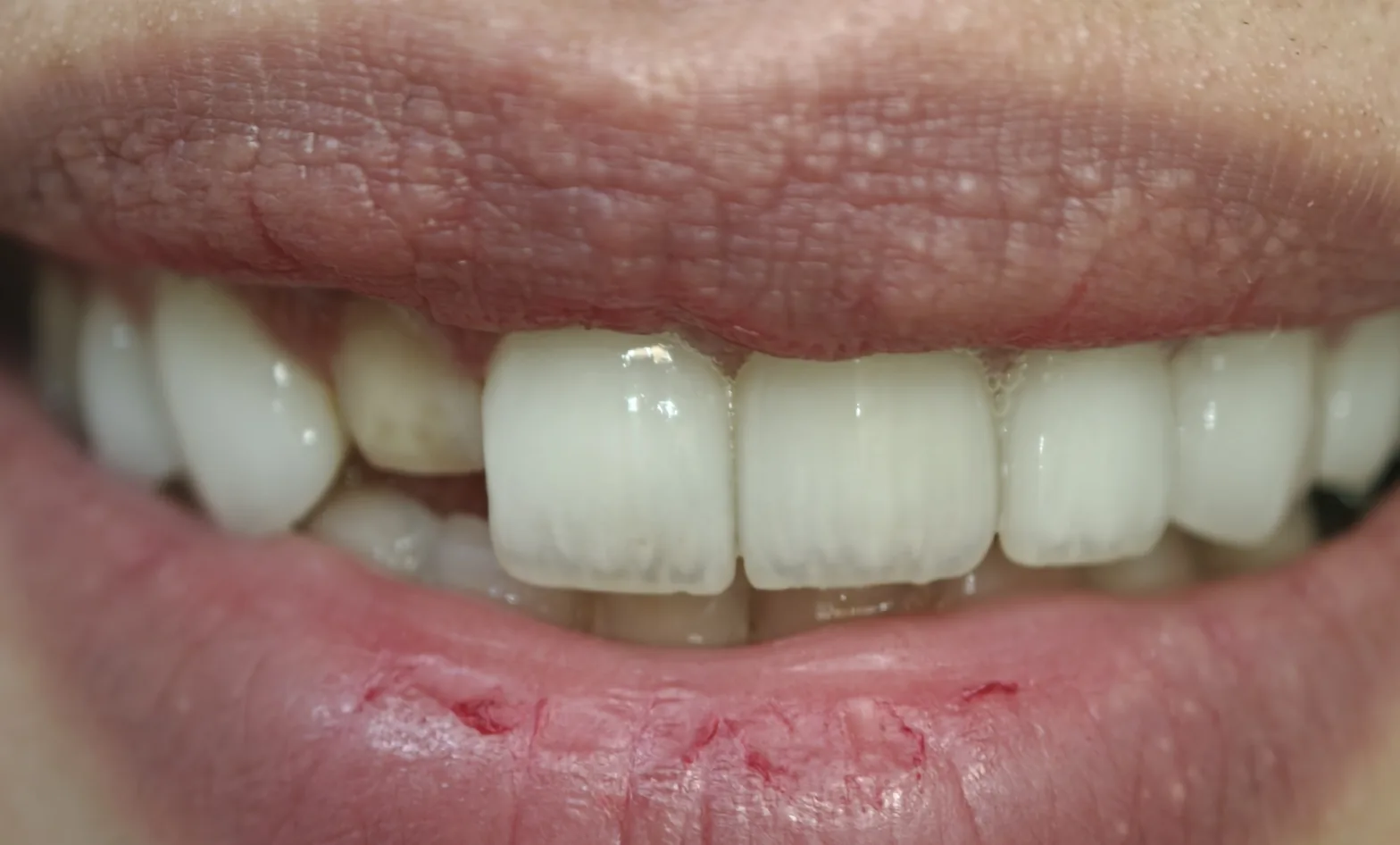
On this basis, there was no current evidence that root canal treatment was necessary; the mere possibility of future necrosis is not sufficient reason to perform prophylactic root canal treatment before restoring the laminate.
∆ 2. Treatment decision and what has to be explained to the patient
The priority at this stage is to cover the prepared surface again and reduce sensitivity, whether by re-cementing the previous laminate (if it is intact and fits well) or by making a new laminate with the original treating dentist.
The patient was told that if he needs root canal treatment in the future, that does not necessarily mean giving up the laminate and converting the treatment to a full crown. In such a case, access to the canal is usually obtained from the palatal side through a conservative cavity so that the labial surface of the laminate is preserved; however, keeping the existing restoration depends on the location and extent of the access, the quality of the bond and the condition of the laminate itself.
It was also explained that even if a definitive indication for root canal treatment existed today, given the amount of healthy tissue and the condition of the tooth walls, root canal treatment alone does not force a full crown, and if the bonding conditions and the remaining structure are suitable, a laminate remains an option worth considering.
∆ 3. Clinical note
In full-crown treatments, prophylactic endodontics is sometimes discussed because of the extent of preparation or structural considerations; but with a laminate, prophylactic root canal treatment makes no sense and has no clinical justification, because even if root canal treatment becomes necessary in the future, it can be carried out without damaging the laminate restoration itself — and that is when the likelihood of needing root canal treatment is low.
A debonded laminate is not, by itself, a sign of a poor prognosis for the tooth or of a need for root canal treatment; just as root canal treatment does not automatically mean the restoration has to become a full crown. The decision must rest on the actual state of the pulp, the amount of healthy tissue, the bonding conditions and the occlusal load; not merely on fear of something that may happen in the future.
This page is intended for educational use by dentists and dental students.