
Insight 53 — A Recurring Design Error in Upper Premolar Crowns Worth Checking Before Fabrication
Published:
Last reviewed:
فارسی
Clinical Explanation
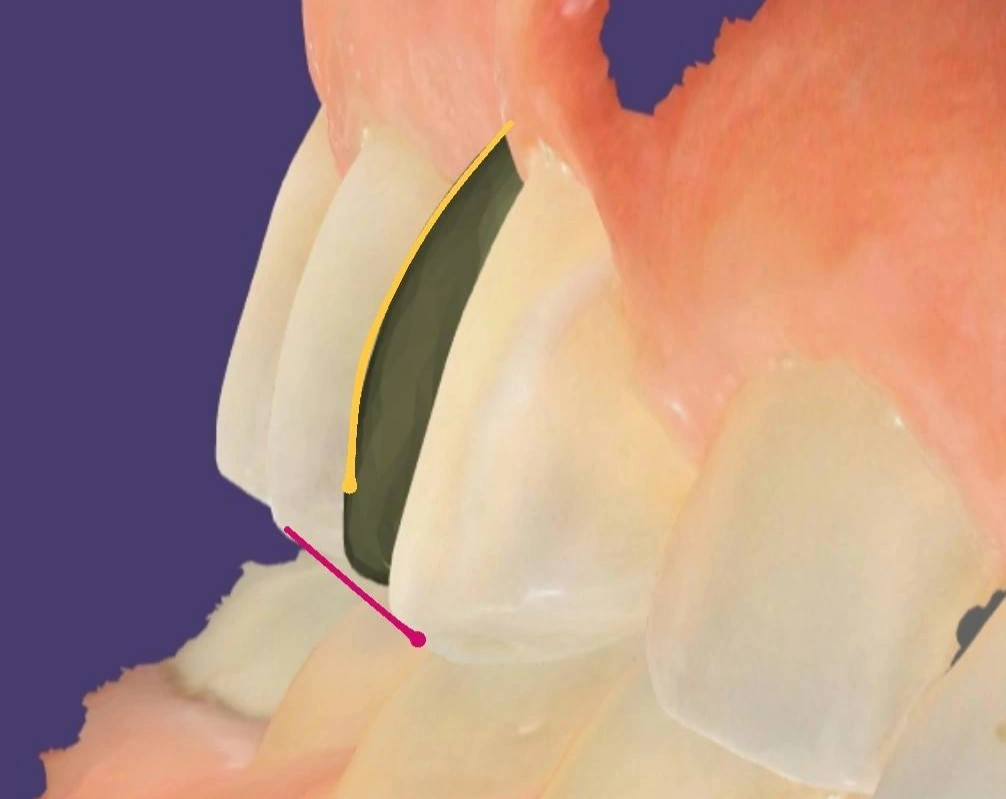
Maxillary first premolar crowns are repeatedly designed with a short buccal cusp and a flat buccal ridge, with the whole crown set back and undersized relative to the canine and second premolar; the occlusion comes out fine, but the buccal contour and cusp height are missed. This pattern is not limited to implants and recurs in non-digital crowns too; the fix is to check the design file against the adjacent teeth before fabrication
-
Case description
This image is the design of an implant crown for a maxillary first premolar that the lab sent for a check before fabrication. On the monitor there is nothing odd about it. Its occlusion is probably fine too. But look at it next to the canine and the second premolar and the problem becomes clear: the buccal cusp is short, the buccal ridge is flat, and the whole crown is set back and designed small relative to the two adjacent teeth. The marking lines show exactly this discrepancy with the neighboring teeth.
This is not an isolated occurrence. It is a pattern I have specifically seen many times in the upper premolar, and one I have had a lot of work remade over. I do not pass judgment on its cause; I only know it recurs, and it is not limited to implants. I have seen this same shortening of the first premolar many times in crowns made by non-digital methods too. The occlusion is worked out correctly, but the buccal contour and cusp height are overlooked. -
Why these two matter
The maxillary first premolar sits at the corner of the smile and is the point where form transitions from the canine to the posterior teeth. The buccal ridge of this tooth maintains the continuity of the contour line from the canine all the way to the molar. When this ridge is made flat and the cusp short, the line between teeth 3 and 5 breaks, and the crown looks under-contoured and sunken. A correct occlusion does not compensate for this, because the issue is not occlusal contact — it is buccal form. -
The extra factor in implants
On an implant, another factor is added to the story: bone changes its contour after tooth extraction, and the cervical region is no longer like the situation of a natural tooth. As a result, the collar of the implant crown comes out different from the adjacent teeth by default, and unless the designer deliberately corrects it, the discrepancy remains in the collar region. That is why, in this case, I asked for the collar to be like the second premolar. -
What I flagged in this design
- Make the cusp taller and bring the buccal ridge into proportion with teeth 3 and 5, then fabricate.
- The collar should be like tooth 5.
- A ridge lap is fine if needed, but the underside of the ridge lap should not be concave. If it is needed for correct form, I will adjust the gingiva myself.
-
The practical takeaway
Checking a design file takes a few minutes. Sending back a finished crown means remaking it, an extra appointment, and lost time for the patient. Because this error has recurred so many times, I have turned it into a working rule: whenever an upper premolar is involved, I ask the lab to send the design before fabrication and I check the buccal contour and cusp height against the adjacent teeth. An error caught at the design stage never reaches the patient's mouth.
The content of this page is intended for the educational use of dentists and dental students.