
Insight 56 — Using a Mirror as Visual Biofeedback for Recording Lateral Movements
Published:
Last reviewed:
فارسی
Clinical Explanation
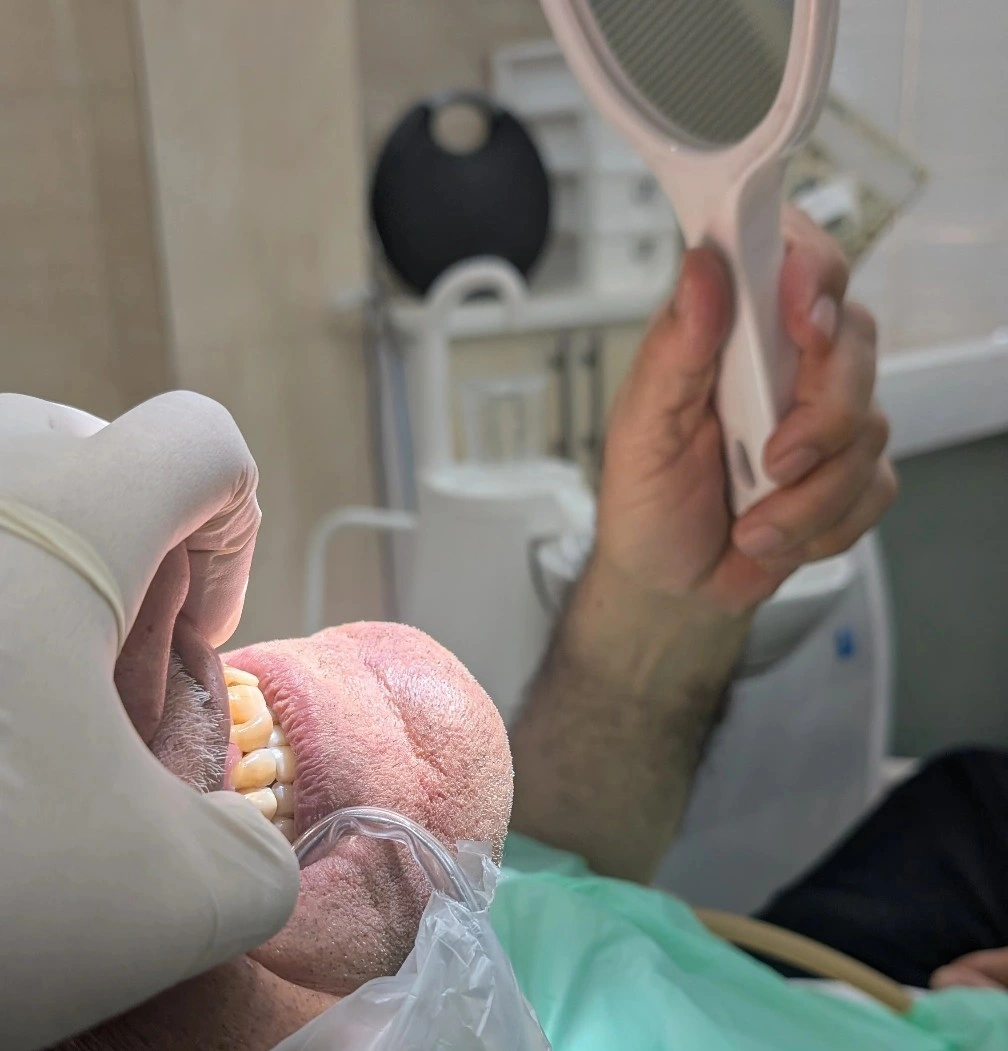
In patients who find jaw orientation and performing the requested lateral movements difficult, a mirror acts as a layer of visual feedback that resolves the ambiguity of the verbal instruction and improves the patient's motor control in the same session
One of the essential steps in the final occlusal adjustment of restorations and crowns is checking the lateral movements of the jaw, to make sure there is no occlusal interference along the movement paths. In patients with poor neuromuscular coordination, or who have trouble following directional (left and right) commands, a mirror can serve as a visual biofeedback tool that improves the patient's motor control within the same session.
-
The Challenge in the Clinic
When checking occlusion during excursive movements, many patients get confused by the verbal command "move your jaw to the left or right." Repeating the sentence or using phrases like "toward me" and "away from me" usually does not help, and the result is one of three outcomes: inappropriate muscle contraction, repeated movement to only one side, or substitution of a protrusive movement instead of a lateral one. This is exactly what makes adjusting the restoration long and tiring. -
The Clinical Solution
The solution is simple: activating the patient's visual feedback pathway.
1. Hand the patient a mirror: Give the patient the mirror so they can directly see their own jaw movement.
2. Making the movement error visible: In the mirror, the patient sees that, despite the instruction to move to both sides, they are unconsciously moving the jaw to only one side.
3. Correcting the movement pattern: Matching the patient's mental image with what they see in the mirror allows them to direct the muscle contraction correctly and perform the lateral movement in the requested direction. -
Take-home Message
In patients for whom jaw orientation and performing the requested lateral movements are difficult, the mirror — as a layer of visual feedback — removes the ambiguity of the verbal instruction, facilitates neuromuscular coordination, and improves the time and accuracy of occlusal adjustment.
The content of this page is intended for the educational use of dentists and dental students.