
Insight 77 — When the Middle Path Serves the Patient
Published:
Last reviewed:
فارسی
Clinical Explanation
This note follows a financial constraint that appeared in the middle of treatment and changed the route to the definitive crown. The point is that when a patient's posterior support rests on nothing but two provisional crowns, the decision about how the definitive work is to be made is no longer merely a laboratory choice; it determines at which moment, and for how long, the patient is left without posterior support.
-
The clinical situation
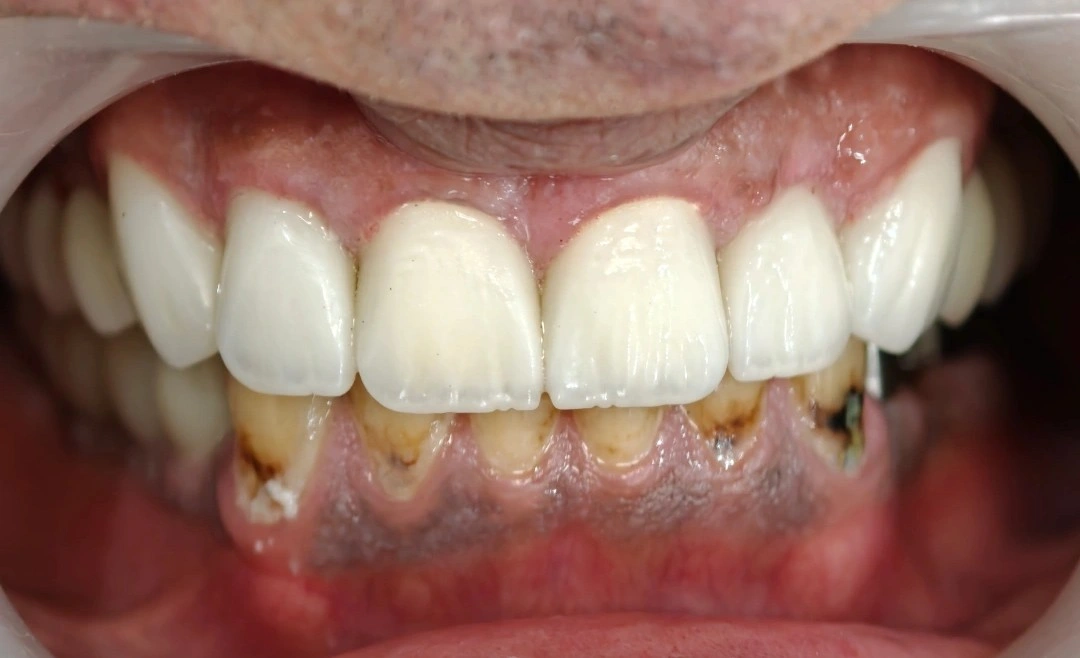
I had a patient for whom I had increased the vertical dimension (VD). The maxilla had been completely rebuilt with definitive restorations, and in the mandible the posterior segments on both sides were being held on implants with provisional crowns. Now it was time to replace those provisional crowns with the definitive ones. -
Changing the laboratory mid-treatment
Before reaching this stage, another important decision had already been taken. The patient had initially intended to have the whole case done at the level of an esthetic treatment and with the laboratory that goes with it, but as rates rose and costs increased we agreed to continue the work with a laboratory whose quality is good but which does not price at esthetic rates. The result was that the laboratory which had made the provisional crowns and the laboratory which was to make the definitive crowns were two different outfits.
This alone took one of the simple routes off the table. Normally the laboratory could have been asked to make the definitive crown from the previous scan, without any new step in the patient's mouth. But when the previous scan sits with another laboratory, that option effectively drops out.
That left us with two routes. -
Route one: scanning at fixture level
The first route was to remove the provisional crowns, scan at fixture level and have the work built from scratch, and then, after the scan, seat the provisional crowns back in place so that the VD would be maintained while the definitive work was being made. The advantage of this method is that the patient is never left without posterior support at any point. But it has a cost problem, because the new laboratory makes new abutments and the patient has to pay for the abutments a second time, while sound, ready abutments are already in his mouth. -
Route two: scanning the existing abutment
The second route was to remove the provisional crown and scan the existing abutment, so that the definitive crown would be built on that same abutment and no extra cost would be imposed on the patient. But in practice this method has one condition: for an accurate match the laboratory also needs the abutment itself, so that it can scan it separately, merge the scans, and then make the definitive crown. That means the abutment has to leave the patient's mouth for a while. -
Why doing both sides at once is dangerous
This is where the real problem shows itself. If we do this for both sides at the same time, the patient loses his posterior support for a period. With the loss of posterior support the VD is not maintained and the occlusal load is transferred to the anterior region, which directly puts the maxillary restorations at risk of damage. That is, to save the cost of the abutments we would have been putting the whole of the maxillary work in jeopardy. -
The middle path: one half-arch at a time
The solution I chose was the middle path: the second route, but one half-arch at a time. I did the left side of the mandible first; the provisional crown and the abutment of that side were removed and went to the laboratory for the definitive crown to be made, while the provisional crown on the right side stayed in place and maintained the VD. After the definitive crown for the left side is delivered and seated, the same process is repeated for the right side.
The result is that the patient does not pay for the abutments twice, at no stage does he completely lose posterior support, the VD is maintained throughout the treatment, and the maxillary restorations stay safe. The treatment takes a little longer, but in exchange the cost is managed and the quality of the final work is not sacrificed. -
What this experience shows
What this experience shows is that a patient's financial limitations, even when they arise in the middle of treatment, do not necessarily mean a choice between “expensive and safe” and “cheap and risky”. Sometimes, by changing the order in which things are done, the advantages of both can be kept.
The content of this page is intended for the educational use of dentists and dental students.