
Insight 78 — Reduced Interocclusal Space in the Posterior Maxilla: What to Do Before Placing Implants?
Published:
Last reviewed:
فارسی
Clinical Explanation
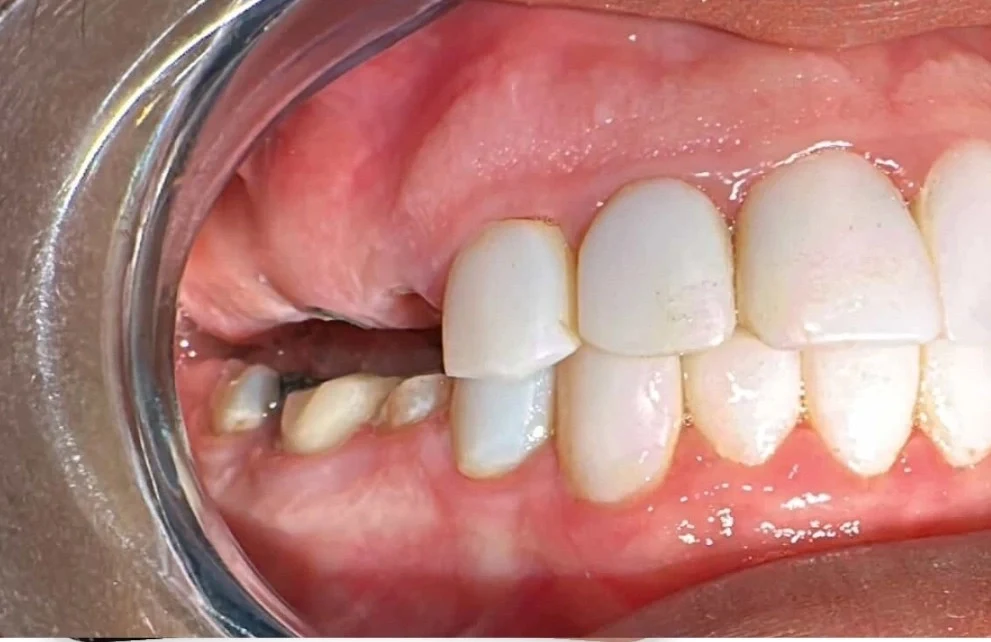
The patient is a candidate for implant treatment in the maxillary first premolar to first molar region, but the interocclusal space in that area has been reduced. The question is whether implants can be placed and the space problem solved with a screw-retained crown, or whether the opposing teeth in the mandible have to be reduced as well.
-
Step one: assess the occlusal plane
Before any decision, the occlusal plane has to be examined. What settles the matter is where the mandibular teeth stand in relation to the plane. If the lower teeth sit within the plane, they must not be touched. In that case the shortage of space has been created from the maxillary side, and the solution has to come from that same side — not by cutting down sound teeth that are in their correct position. -
Step two: create the space from the maxillary side
When the lower teeth are within the plane, the space is gained at the surgical stage:- After the teeth in the area are extracted, the bone is contoured and an osteoplasty is performed to reduce the height of the ridge.
- The implants are placed in the correct position and are not set too superficially. Placing the implant roughly one to two millimetres deeper provides more prosthetic space.
-
Step three: choose the type of prosthesis
If space is still short after these measures, that is when we turn to a screw-retained prosthesis. In other words, a screw-retained prosthesis is not a substitute for correcting the space; it is an option for when the space has remained limited despite osteoplasty and an adequate implant depth. -
Summary
The order of decision-making in this patient runs as follows: first assess the occlusal plane; then preserve the opposing teeth if they are within the plane; next create space with osteoplasty and by placing the implant deeper; and finally choose a screw-retained prosthesis if the space is still not sufficient.
The content of this page is intended for the educational use of dentists and dental students.