
Insight 87 — Why Are Lateral Excursions Designed as Canine Guidance, Not Anterior Group Function, in Full-Arch Rehabilitation?
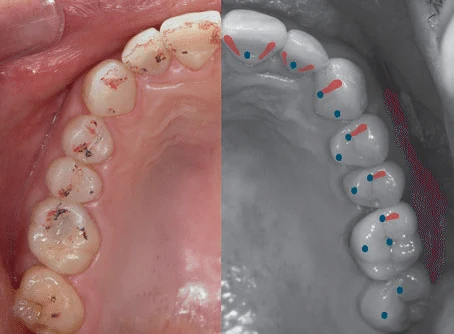
Clinical Explanation
Question
Occlusion textbooks say that anterior group function is a sound design, because the load of lateral excursions is spread across several anterior teeth and these teeth are farther from the fulcrum (the joint). So why, in full-arch rehabilitations, are lateral excursions usually designed as a canine rise rather than anterior group function?
Answer
Before answering, one point needs to be made clear: canine guidance and anterior group function are not two competing designs with a definite winner. Both are subsets of one shared principle; in lateral excursions, the posterior teeth must disclude immediately and the load of the lateral movement must fall on the anterior teeth. Whether the canine does this alone or with the help of the lateral incisor (and sometimes the central), is a secondary decision.
With that as a preface, two reasons explain why canine guidance is the more common choice in full-arch rehabilitation.
The first reason is tooth biomechanics. The argument of "being farther from the fulcrum" is really a lever argument: the mandible rotates like a lever around the joint, and the farther a contact point is from the joint, the less force reaches that point for the same muscle force. In anterior group function, the canine is still in contact and the lateral incisor is added to it; so the load is divided between two teeth and part of it reaches a tooth that is farther from the joint. This advantage is real in theory. The problem begins with the fact that the tooth being added to the group is the weakest tooth in the arch: the lateral incisor has the shortest and thinnest anterior root, while the canine has the longest root, the best crown-to-root ratio and the densest surrounding bone, and on its own it is sufficient to bear the entire load of the lateral movement. In other words, canine guidance does not lose anything that would need the lateral incisor's help to compensate, and anterior group function, in exchange for reducing the load on the canine, places part of the load on the tooth with the least capacity to bear it. How large this part is in practice, and whether it is the same amount that was intended in the design, comes down to the second reason.
The second reason is controllability and predictability. Canine guidance is a single contact point that is easily designed, fabricated and checked in the mouth. Anterior group function means simultaneous, coordinated contact of the canine and the lateral incisor (and sometimes the central) throughout the lateral movement. Achieving this coordination in the laboratory is difficult, and it is disrupted by a small error in fabrication, adjustment or cementation. The main problem is that when this coordination is lost, it is impossible to predict how the load will be divided; the lateral incisor's share may become larger than intended, the central may become involved, and a different pattern may form in different lateral movements. That is, what was planned in the design is not necessarily what happens in the mouth, and if the lateral incisor's share becomes excessive, the load is concentrated on the weakest tooth in the arch. With canine guidance this uncertainty is far smaller, because a single defined contact can be seen, measured and corrected.
In summary, when it is said that canine guidance "is easier to fabricate", this is exactly what is meant: one defined contact that can be controlled, checked and corrected, versus several simultaneous contacts that are difficult to keep coordinated and where the result of an error is unpredictable. It is a conservative choice that places the load on the most resistant tooth in the arch.
The content of this page is intended for the educational use of dentists and dental students.