
Insight 95 — Full-Mouth Rehabilitation: Where Do We Start Treatment?
Clinical explanation
This patient presented with severe tooth destruction, multiple edentulous spans, and occlusal problems. We plan a full-mouth rehabilitation, but the issue is not only which teeth receive crowns or where implants are placed. The main challenge is designing a treatment path whose stages stay coordinated with one another.
I want to explain the roadmap I have in mind for treating this patient.
Current patient status
The maxillary anterior teeth are severely destroyed, with much of their enamel lost. From the history, the patient had been using lemon juice while brushing for a period, which likely involved a combination of erosion and abrasion in producing this situation.
In the mandibular anterior region there is an implant-supported bridge whose form and dimensions are unsuitable, and I intend to replace it. Posteriorly there are also multiple edentulous spans whose reconstruction with implants is part of the treatment plan.
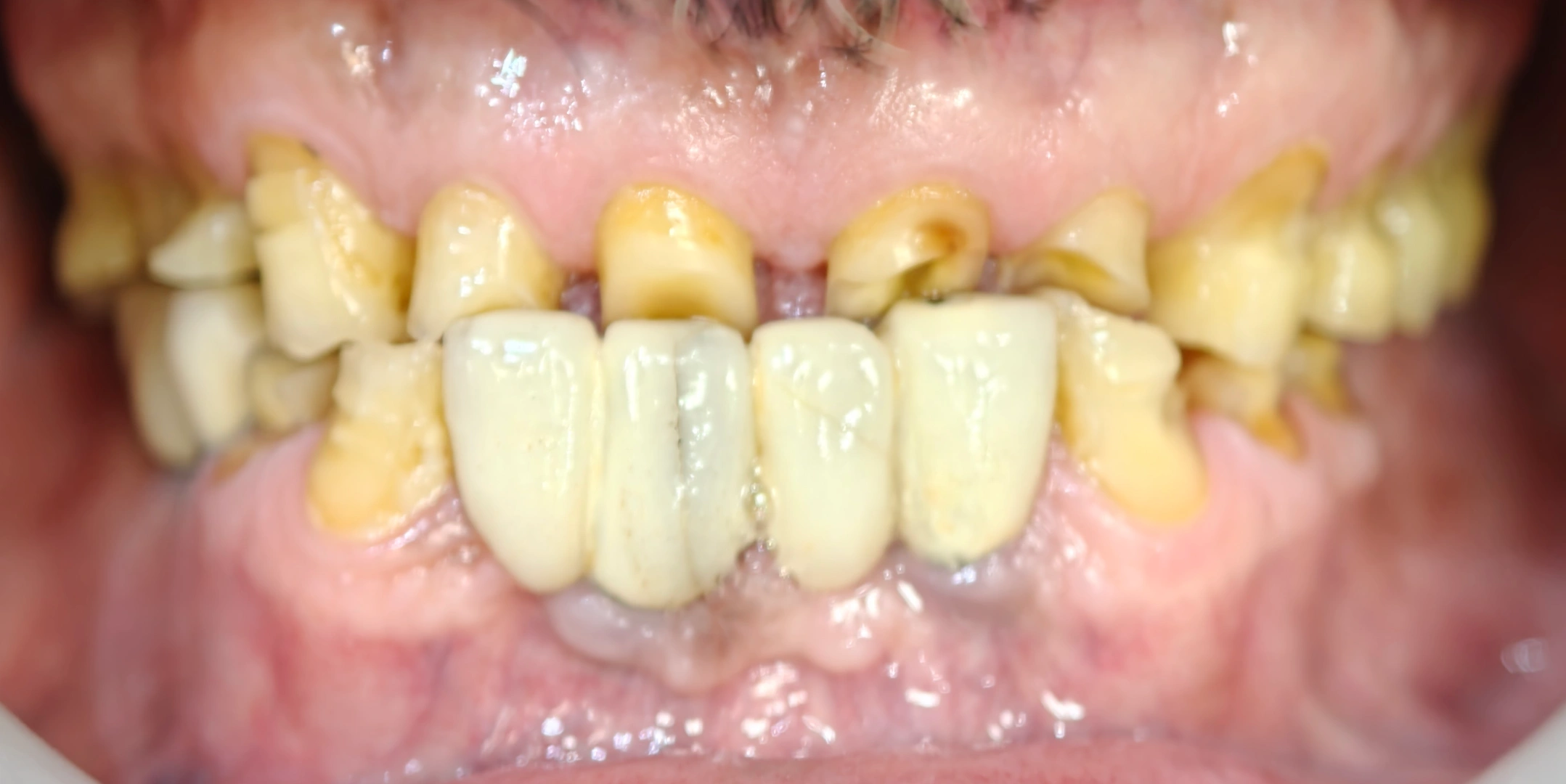
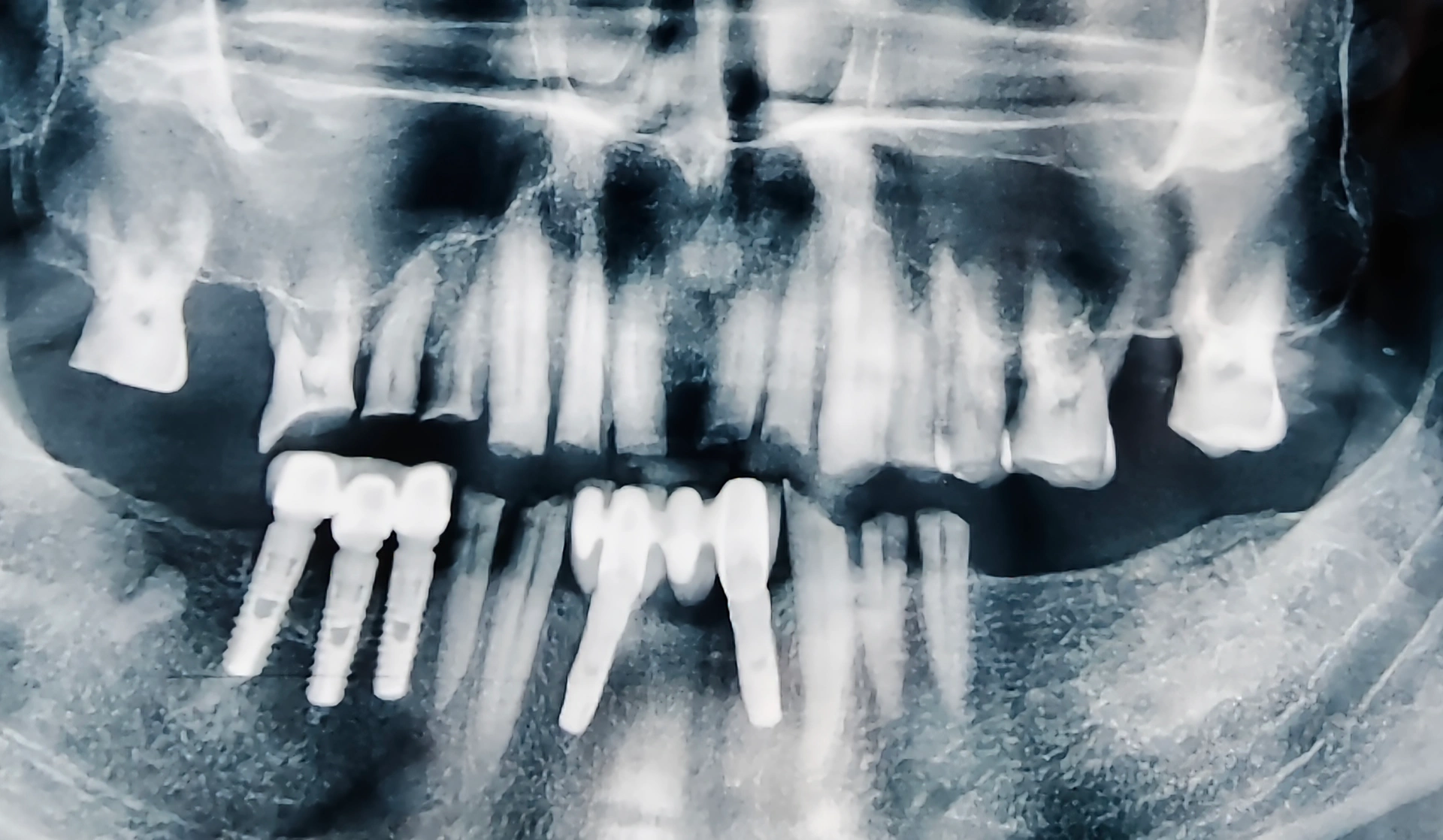
An important point is that I do not make completing the rehabilitation of the remaining teeth dependent on the posterior implants being ready. We can restore the remaining teeth and reach an acceptable, stable occlusion even if the posterior prostheses have not yet been delivered.
This approach aligns with the Shortened Dental Arch (SDA) concept: acceptable function does not necessarily require replacing every posterior tooth. Whether it can be applied depends on the number and distribution of occlusal units and the patient’s functional conditions.
So the posterior implants are part of the comprehensive plan, but finishing them is not a precondition for completing the rehabilitation of the remaining teeth.
Stage 1: Tooth assessment and prosthetic design
Before any intervention, the prognosis of each tooth must be established. For that we assess remaining sound structure, periodontal and endodontic status, the feasibility of an adequate ferrule, and whether each tooth can be restored reliably.
This assessment must happen from the start so we know which teeth will be retained and which cannot be kept. We then base the prosthetic design on the teeth we can truly count on preserving.
Next, an intraoral scan, jaw-relation records, and the required images are obtained.
One of the important decisions at this stage is determining the vertical dimension of occlusion (VDO). Severe tooth destruction does not necessarily mean a reduced VDO; we must decide whether the existing vertical dimension is appropriate or whether changing it is needed to provide restorative space and achieve desirable occlusal relations.
After these reviews, we do a digital design or diagnostic wax-up with a facially driven approach: tooth positions are designed with the face, lips, and smile in mind, while functional, phonetic, and occlusal constraints are considered at the same time.
Provisionals are fabricated from this design.
For me, provisionals are not merely temporary crowns; they are meant to be the treatment roadmap. With them we can try the proposed design in the mouth, check occlusal relations and esthetics, and change them if needed.
Stage 2: Initial surgery
Teeth judged non-restorable in the initial assessment are extracted at the earliest suitable time. The timing of each extraction is set according to any likely role that tooth may play in supporting the provisionals and the order of treatment stages.
The aim is that these teeth are decided from the outset, so we are not forced mid-rehabilitation to change the prosthetic plan because of a late decision.
At the same stage we also place the posterior implants according to the prosthetic plan so that their osseointegration period runs in parallel with the continuing rehabilitation stages.
In this way, treatment of the remaining teeth continues without a mandatory dependence on completing the posterior implants.
Stage 3: Preparing the remaining teeth
Endodontic, restorative, and periodontal treatments are carried out according to each tooth’s needs.
In severely destroyed teeth, achieving an adequate ferrule is one of the main issues. If ferrule or restorative space is insufficient, we first review the available options.
Clinical crown lengthening is one of those options, but it is not done routinely. Especially in the maxillary anterior region, we must weigh its esthetic and periodontal consequences and the change in crown-to-root ratio.
Root canal treatment and core build-up are performed only for teeth that truly indicate them.
Throughout this stage, the provisionals are adjusted as needed so they stay coordinated with changes in the teeth and surrounding tissues.
Stage 4: Evaluating and confirming the provisionals
Before fabricating the definitive restorations, we must be sure the proposed design is also acceptable in the patient’s mouth.
At this stage we review esthetics, phonetics, occlusal relations, patient comfort, and the feasibility of hygiene. If VDO has been changed, the patient’s tolerance of that change is also assessed.
Once an acceptable, stable situation is reached, we record the information from the approved provisionals so they become the basis for fabricating the definitive restorations.
The goal is that the definitive restorations are built from a design already tried and revised in the mouth, not solely from an initial wax-up.
Stage 5: Delivering the definitive restorations
After the necessary treatments are complete, the definitive restorations are fabricated from the approved design.
Material and restoration type depend on each site’s conditions, available space, esthetic needs, and occlusal status. The quality of finishing and polishing of occlusal surfaces—especially after adjustments—matters for limiting wear of opposing teeth.
The mandibular anterior implant bridge will also be replaced with a new design.
Posterior reconstruction proceeds according to implant status and at the appropriate time. As posterior prostheses are added, occlusal relations are rechecked and adjusted if needed.
Stage 6: Protection and follow-up
Delivering the restorations does not end the work.
Controlling the factors that caused tooth destruction—especially the habit of using lemon juice while brushing—is an important part of treatment.
The patient’s parafunctional status is also reviewed, and if indicated a hard occlusal splint will be made to reduce the risk of damage to teeth and restorations.
Periodic follow-up of occlusion, restorations, periodontal tissues, and implants is also part of the treatment plan.
Closing note
In this case, the main challenge is not only restoring destroyed teeth; it is coordinating the different stages of treatment.
I prefer that tooth prognoses are clear from the start and that the prosthetic plan is set around retainable teeth. I then use provisionals as the treatment roadmap and carry surgical, endodontic, and restorative steps within that framework.
Of course not every decision is meant to be final on day one. Some of them—such as keeping or changing VDO and the final details of the rehabilitation—are settled after further review and evaluation of the provisionals.
What matters is knowing from the outset where we want to go, while keeping enough flexibility along the way to revise decisions.
The content of this page is intended for the educational use of dentists and dental students.