
Seeing a Pregnant Patient in the Dental Office
Seeing a pregnant patient is the same as seeing any other patient, with a few differences you should know before you start. This article follows the order of the visit itself: what to ask, when and with which anesthetic and drugs to treat, and what to tell the patient after treatment.
∆ 1. Three questions that decide the course of treatment
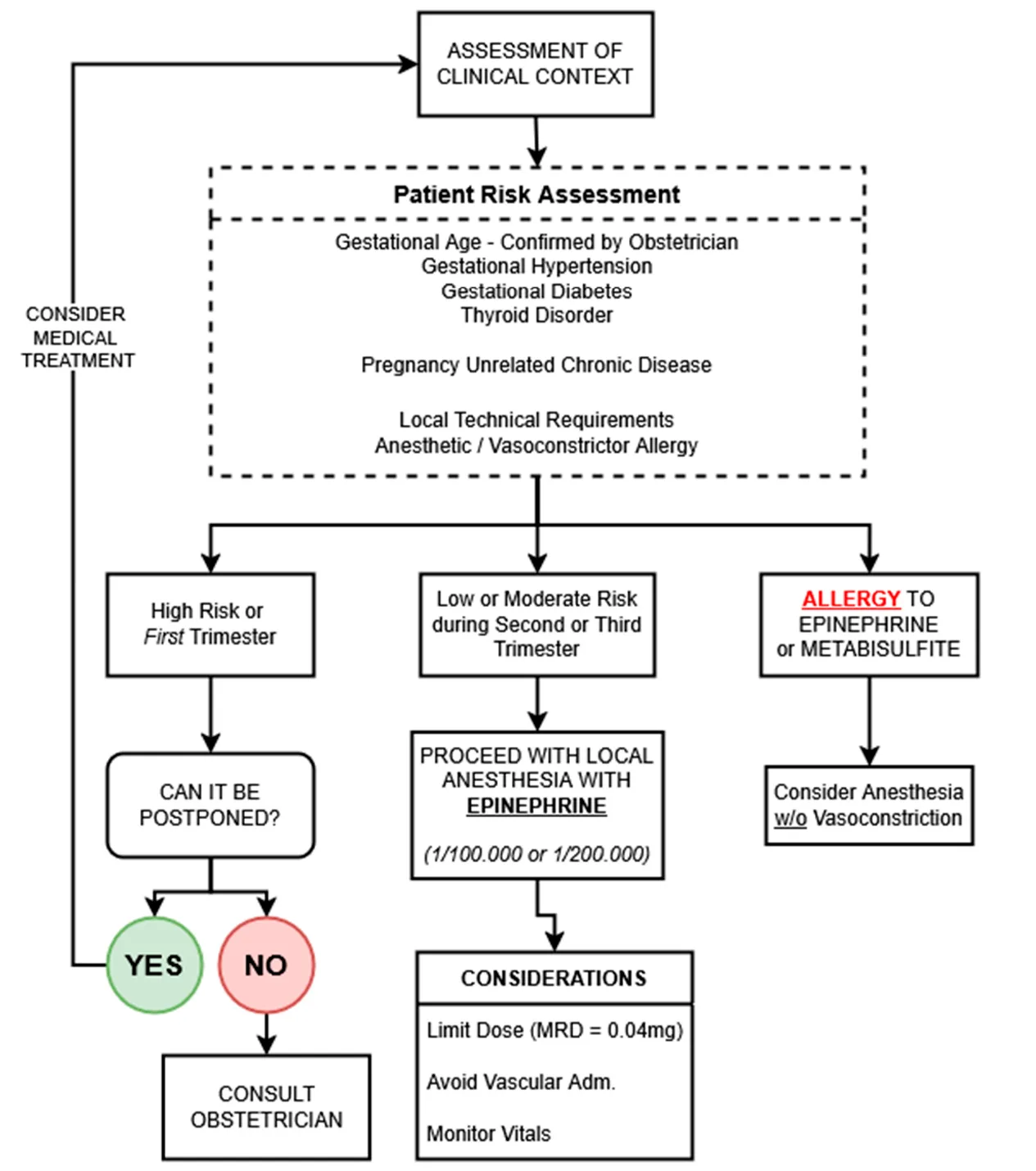
- How many weeks pregnant is she? The choice of analgesic and the permitted duration of sedation depend on gestational age (sections 5 and 6).
- Does she have an underlying disease or a pregnancy complication?
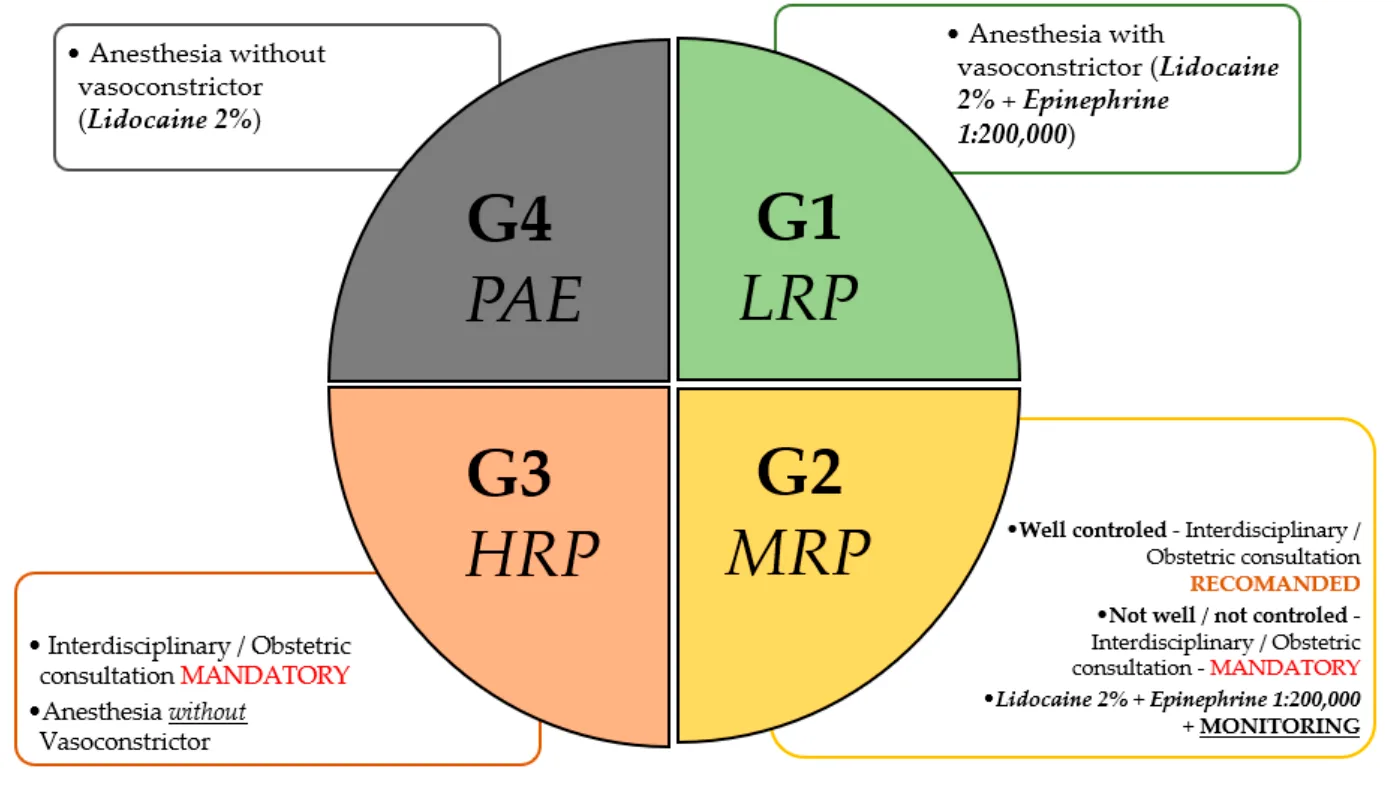
- If the patient has preeclampsia (a pregnancy complication accompanied by high blood pressure), unstable cardiovascular disease, severe arrhythmia (a severe irregularity of the heartbeat) or a recent history of thromboembolism (a clot that formed in a vessel and travelled elsewhere), she is a high-risk patient. Coordinate with her physician before treatment and do not use anesthetics that contain a vasoconstrictor (section 4).
- If the patient has gestational hypertension or gestational diabetes that is under control, more monitoring is needed during treatment, and in some cases her physician should be consulted before treatment.
- If the patient has diabetes, high blood pressure, heart or lung disease, or a bleeding disorder, coordinate with her physician before treatment, because these conditions may affect the course of dental treatment.
- Is she vomiting, and how often? If so, give her the instruction to rinse her mouth after vomiting (section 7).
∆ 2. Timing of treatment
- Dental treatment is not prohibited in any week of pregnancy, and preventive, diagnostic and restorative treatment and root canal treatment can be done in every trimester.
- Treat pain, infection and any other acute condition right when it appears, and do not wait for a particular trimester.
- Treatment that is not urgent and that the patient has chosen (such as cosmetic work) is better done in the second trimester, although doing it in the first and third trimesters is not prohibited.
- Do not postpone necessary treatment, and plan it so that it is finished before delivery, because delaying treatment is itself a risk; for example, a severe infection of one tooth can spread through the body.
∆ 3. Radiography
- Radiography is safe throughout pregnancy.
- Take it whenever it is needed for assessment and definitive diagnosis.
In my opinion, if the patient is worried and the apron is not in the path of the beam, using it for the patient's peace of mind does no harm, although it offers no significant benefit in dose reduction.
∆ 4. During treatment
Anesthesia: first know what is in the cartridge
Anesthetic cartridges usually have two main components: the anesthetic agent itself (such as lidocaine or prilocaine) and a vasoconstrictor. The vasoconstrictor narrows the vessels at the injection site so that the anesthetic is absorbed into the blood more slowly, is deeper and lasts longer, and there is less bleeding. In pregnancy the type of vasoconstrictor matters, because they are not all the same. The three common types are epinephrine, felypressin and levonordefrin. Before injecting, read the composition on the cartridge or its box and see which vasoconstrictor it contains.
Epinephrine (adrenaline) Permitted
- Anesthetics whose vasoconstrictor is epinephrine, such as lidocaine, mepivacaine, prilocaine and bupivacaine with epinephrine, can be used in pregnancy.
- Epinephrine is the only vasoconstrictor with acceptable safety in pregnancy, provided it is injected at a low dose and with the correct technique.
- Always aspirate before injecting, use the lowest effective concentration of epinephrine, and limit the epinephrine dose to a maximum of 0.04 mg per session. This is roughly equal to 4 mL of a 1:100,000 solution or 8 mL of a 1:200,000 solution.
Felypressin Do not use
- Structurally, felypressin resembles vasopressin, one of the body's natural hormones that narrows vessels. Its problem in pregnancy is that it has an oxytocic effect, meaning that, like the hormone oxytocin that contracts the uterus during labor, it can cause uterine contractions and preterm labor. This risk is raised especially in the second and third trimesters.
- The most common anesthetic that contains felypressin is Citanest 3% with Octapressin, which is prilocaine 3% with felypressin. Octapressin is simply felypressin under its brand name.
- So if felypressin or Octapressin is written on the cartridge or box, do not use it for a pregnant patient. Prilocaine itself is not a problem; prilocaine with epinephrine is permitted, and the problem arises only when its vasoconstrictor is felypressin.
Levonordefrin Do not use
- Levonordefrin is another vasoconstrictor, usually supplied with mepivacaine 2% at a concentration of 1:20,000. It raises the mother's blood pressure more than epinephrine, theoretically it can reduce uterine blood flow, and there is not enough data on its safety in pregnancy.
- If levonordefrin is written on the cartridge, do not use it for a pregnant patient. Mepivacaine alone, or with epinephrine, is not a problem.
Articaine Do not use
Do not use articaine unless you have consulted the patient's physician.
Sulfite allergy
Anesthetic solutions that contain epinephrine contain a substance called metabisulfite, which is added as an antioxidant. If the patient is allergic to sulfite, use mepivacaine 3% without a vasoconstrictor (plain).
Restorative materials
Use standard restorative materials and methods, but if a suitable alternative exists, do not use amalgam during pregnancy.
Rubber dam
Use a rubber dam in root canal treatment and restorative work.
Patient position on the unit
- The patient's head should be higher than her feet.
- Place the patient in a semi-reclined position, as far as she can tolerate, and let her change position during the work.
- If the patient becomes dizzy or nauseated because of a drop in blood pressure, put a small pillow under her right hip or ask her to turn slightly to the left. In the last months of pregnancy, when the patient lies on her back, the enlarged uterus presses on the main vessels of the abdomen (the aorta and the inferior vena cava) and less blood returns to the heart; turning to the left removes this pressure.
Monitoring
Monitor the patient's vital signs (blood pressure and heart rate) during treatment, and in patients at moderate and high risk, keep the patient under observation for a while after treatment as well.
∆ 5. Medication
Analgesics
- Permitted Acetaminophen is permitted throughout pregnancy and is the first choice, because oral pain can often be controlled without opioid analgesics.
- With restrictions Opioid analgesics or opioids (acetaminophen with codeine, hydrocodone, oxycodone, codeine, meperidine and morphine) are permitted, but at the lowest dose and for the shortest time, which is usually less than 3 days, and without repeat prescriptions so that the risk of dependence is reduced.
- With restrictions Ibuprofen, naproxen and aspirin are permitted only in specific windows of pregnancy (section 6).
Antibiotics
- Permitted Amoxicillin, penicillin, cephalosporins (such as cephalexin), clindamycin and metronidazole.
- Do not use Ciprofloxacin, levofloxacin, moxifloxacin and clarithromycin.
- Never Tetracycline must never be prescribed in pregnancy.
Sedation and anesthesia
- Do not use Do not use nitrous oxide (a gas given through the nose to calm the patient) unless you have consulted the patient's physician.
- With consultation General anesthesia, intravenous sedation (a sedative injected into a vein) and inhalation sedation (alone or together with a sedative pill) should be carried out only after consulting the patient's physician.
Mouthrinse
- In pregnancy, use alcohol-free products.
- Permitted Chlorhexidine mouthrinse, cetylpyridinium chloride (CPC) mouthrinse and xylitol (a sweetener that reduces the bacteria that cause caries).
∆ 6. What changes with gestational age
- Up to week 12 Ibuprofen, naproxen and aspirin should not be used, and the analgesic of choice is acetaminophen.
- Weeks 13 to 20 Ibuprofen, naproxen and aspirin can be prescribed for a short period, at most 48 to 72 hours.
- Weeks 20 to 27 The use of ibuprofen, naproxen and aspirin should be limited.
- Third trimester Ibuprofen, naproxen and aspirin should not be used. If general anesthesia or sedation (with physician consultation) is needed in the third trimester, its duration should be less than 3 hours. In anesthesia, the risk of felypressin is higher in this period (section 4).
Exception for low-dose aspirin: Low-dose aspirin (usually baby aspirin) is permitted from week 12 onward for women at high risk of preeclampsia.
∆ 7. Pregnancy-specific instructions for the patient
- Explain to the patient that the changes in the body during pregnancy can make the gums painful or swollen and make them bleed. This condition is called gingivitis (inflammation of the gums), and if it is not treated it can progress to periodontal disease (disease of the tissues that support the teeth) and eventually to tooth loss.
- After every episode of vomiting, she should rinse her mouth with a solution of one teaspoon of baking soda in a glass of water so that the acid does not damage the teeth.
- If she feels nauseated, she should eat small amounts of healthy food throughout the day instead of large meals.
- Every night she should use an alcohol-free fluoride mouthrinse.
- After meals she should chew gum or use products that contain xylitol.
- She should tell the dentist that she is pregnant and give her due date.
∆ 8. After delivery
- The newborn should be fed only breast milk for at least 4 months and ideally 6 months.
- From 6 months of age, the child's physician should assess the child's mouth for the risk of oral disease and, if urgent treatment is needed, refer the child to a dentist.
- The child should be taken to the dentist for the first time by the age of one.
∆ References
- Urîtu A, Buciu VB, Roi C, et al. Review of the Safety and Clinical Considerations of Vasoconstrictor Agents in Dental Anesthesia During Pregnancy. J Clin Med. 2025;14(13):4773. doi:10.3390/jcm14134773
- Oral Health Care During Pregnancy Expert Workgroup. Oral Health Care During Pregnancy: A National Consensus Statement (rev. ed.). Washington, DC: National Maternal and Child Oral Health Resource Center; 2026.
- Lee ET, Ozumba EN, Bevan JR. A randomized trial of Citanest with Octapressin for relief of pain associated with laser vaporization of the cervix. Br J Obstet Gynaecol. 1986;93(9):967-969. doi:10.1111/j.1471-0528.1986.tb08017.x
- The two figures above (the patient classification and the anesthetic-choice algorithm) are reproduced from the first article in this list under a CC BY 4.0 license.