
One or Two Remaining Teeth in an Implant-Restored Jaw: Keep Them or Extract Them?
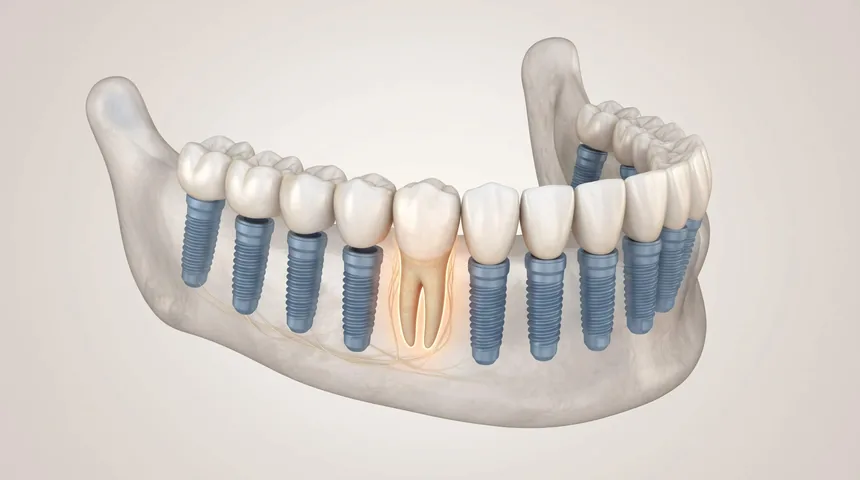
Suppose almost an entire jaw is going to be rebuilt with implants and only one or two natural teeth remain. Is it better to keep these teeth, or to remove them as well in order to reach a fully implant-supported prosthesis?
One of the common reasons for keeping these teeth is proprioceptive sensation: a sense produced with the help of receptors in the periodontal ligament (PDL). But the question is how much this sense really matters for chewing function, and whether the weight given to it is real or exaggerated.
1. The role of the natural tooth in controlling chewing force
Periodontal ligament receptors are sensitive to very small forces, even the forces produced at the first contact of the tooth with the food. Using this information, the brain can adjust the position of the food and the amount of force needed to bite.
Put simply, these receptors help the chewing force match the texture and resistance of the food from the very first contact: not so high that the food is compressed too much, and not so low that control over it is lost.
For this reason, the main role of these receptors should be seen as fine regulation of force, not an increase in chewing power [1].
In patients whose two jaws have both been restored with fixed implant-supported prostheses, this natural feedback is absent. Studies have shown that these patients use more force to hold food, and at the start of chewing the food is more likely to slip between the teeth [2, 3].
2. Can an implant have sensation too?
Of course, an implant is not a completely insensate structure. After osseointegration, a kind of sensory feedback called osseoperception develops, which carries part of the tactile information to the nervous system [4].
This feedback improves with time and with the implant being placed under functional loading [5]. The nervous system also appears to adapt itself to the new situation [6].
Even when the tooth opposing the implant has been anesthetized, the patient can still feel the contact through the implant [7].
Nevertheless, osseoperception is not a complete replacement for the sensation that comes from the periodontal ligament. The accuracy and quality of the implant's sensory feedback is still lower than that of a natural tooth [4, 5].
This is the important point: having or not having a natural tooth is not an all-or-nothing situation. A patient who has lost their teeth and received implants does not lose their sensation completely; part of it comes back through osseoperception and even improves as function continues [5]. So what is gained by keeping one or two teeth is not the whole of proprioceptive sensation, but the gap that remains between the sensation of a natural tooth and the sensation of an implant.
3. Can keeping one natural tooth make up for this deficit?
There is an interesting finding here: an implant that opposes a natural tooth shows better tactile feedback than an implant that opposes another implant [5].
So, if the remaining natural tooth is in occlusal contact with the implant-supported prosthesis of the opposing jaw, it may help improve the patient's sensory feedback.
But this finding should not lead to the conclusion that the presence of even one natural tooth necessarily improves chewing function. Studies have shown that patients with tooth-supported fixed bridges in both jaws also have trouble controlling food and regulating force [2, 3].
So the mere presence of a periodontal ligament is not enough to guarantee better function.
4. The other side of the story: what does keeping the tooth cost?
Alongside the possible sensory advantage, keeping a natural tooth next to an implant-supported prosthesis can cause problems.
Over time, a natural tooth keeps moving and gradually erupting, while the implant stays fixed in the bone. This difference in behaviour can gradually open the contact between the natural tooth and the implant-supported prosthesis.
In studies of implant-supported prostheses next to natural teeth, this phenomenon has been reported in 41 percent of cases, and it is more common on the mesial side [8].
In addition, the occlusal surfaces of the natural tooth and the implant-supported prosthesis may also gradually come to differ in height [9, 10].
Beyond these issues, the remaining tooth is still exposed to periodontal and endodontic problems. If such a tooth is lost after the prosthesis has been delivered, modifying the existing prosthesis may be complicated and costly.
5. In the end, should we keep the tooth or not?
The main question is not whether a natural tooth is better than an implant in terms of sensation; the answer to that is largely clear. The more important question is whether keeping one or two natural teeth in an implant-restored jaw produces a measurable and meaningful functional improvement for the patient.
In the search carried out, no study was found that directly compared these two situations. Therefore, keeping the tooth cannot be recommended as a definitive principle on the basis of the proprioceptive advantage alone.
It seems that the final decision should be made on the basis of three factors:
- Tooth prognosis: does the tooth have an acceptable periodontal, endodontic and structural prognosis?
- Occlusal position: is the tooth in contact with the implant-supported prosthesis of the opposing jaw, and can it play a part in sensory feedback?
- Prosthetic consequences: does keeping the tooth make the design, fabrication and maintenance of the prosthesis more complicated?
Bottom line
In fact, keeping a natural tooth makes more sense when, in addition to having a suitable prognosis, it also provides a clear functional or prosthetic advantage. Proprioceptive sensation is a real advantage, but part of it is compensated by osseoperception. For this reason, this sensation alone is not enough to justify keeping every remaining tooth.
∆ References
All sources were reviewed at the abstract level.
- Trulsson M. Sensory and motor function of teeth and dental implants: a basis for osseoperception. Clin Exp Pharmacol Physiol. 2005;32(1-2):119-22. PubMed · DOI (abstract)
- Svensson KG, Trulsson M. Impaired force control during food holding and biting in subjects with tooth- or implant-supported fixed prostheses. J Clin Periodontol. 2011;38(12):1137-46. PubMed · DOI (abstract)
- Grigoriadis J, Trulsson M, Svensson KG. Motor behavior during the first chewing cycle in subjects with fixed tooth- or implant-supported prostheses. Clin Oral Implants Res. 2016;27(4):473-80. PubMed · DOI (abstract)
- Song D, Shujaat S, Politis C, Orhan K, Jacobs R. Osseoperception following dental implant treatment: A systematic review. J Oral Rehabil. 2022;49(5):573-585. PubMed · DOI (abstract)
- Singh A, Pokarram SS, Podder S. Comparative analysis of active tactile sensibility in single dental implant and natural teeth: A systematic review of clinical studies. J Prosthet Dent. 2026;135(6):e34-e43. PubMed · DOI (abstract)
- Habre-Hallage P, Dricot L, Jacobs R, van Steenberghe D, Reychler H, Grandin CB. Brain plasticity and cortical correlates of osseoperception revealed by punctate mechanical stimulation of osseointegrated oral implants during fMRI. Eur J Oral Implantol. 2012;5(2):175-90. PubMed (abstract)
- Enkling N, Heussner S, Nicolay C, Bayer S, Mericske-Stern R, Utz KH. Tactile sensibility of single-tooth implants and natural teeth under local anesthesia of the natural antagonistic teeth. Clin Implant Dent Relat Res. 2012;14(2):273-80. PubMed · DOI (abstract)
- Bento VAA, Gomes JML, Lemos CAA, Limirio JPJO, Rosa CDDRD, Pellizzer EP. Prevalence of proximal contact loss between implant-supported prostheses and adjacent natural teeth: A systematic review and meta-analysis. J Prosthet Dent. 2023;129(3):404-412. PubMed · DOI (abstract)
- Papageorgiou SN, Eliades T, Hämmerle CHF. Frequency of infraposition and missing contact points in implant-supported restorations within natural dentitions over time: A systematic review with meta-analysis. Clin Oral Implants Res. 2018;29 Suppl 18:309-325. PubMed · DOI (abstract)
- Polymeri A, Li Q, Laine ML, Loos BG, Wang HL. Occlusal Migration of Teeth Adjacent to Implant Prostheses in Adults: A Long-Term Study. Int J Oral Maxillofac Implants. 2020;35(2):342-349. PubMed · DOI (abstract)