
The Case-Control Study
This Part
In the previous parts we saw that, to answer the question “does this factor cause that outcome?”, the strongest tool is the RCT, and when an RCT is not possible or not ethical, the cohort takes its place. A cohort moves from factor to outcome: first it is known who was exposed and who was not, and then both groups are followed over time to see in which group the outcome occurs more often. The problem is that if the outcome is rare, or appears years after the factor, this wait is sometimes not practical. This part is about a study that travels the same path in reverse.
The reverse of the cohort path
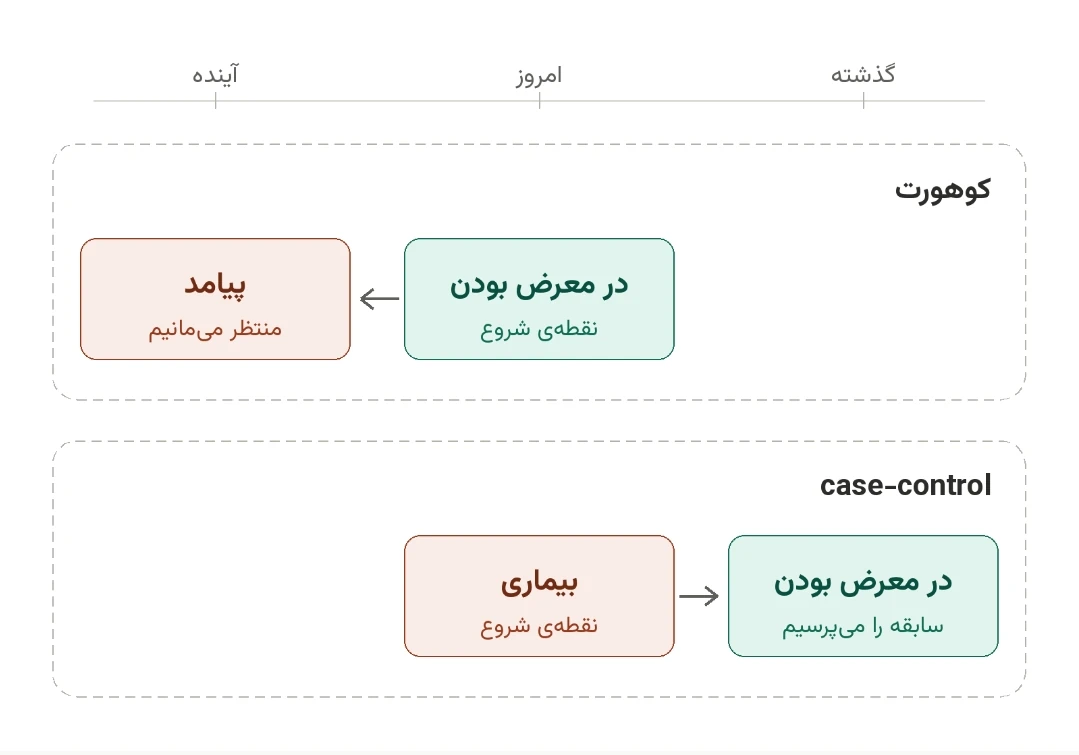
In a case-control study, the researcher starts from the outcome. They find a group of people who have the disease or condition of interest; these are called cases. Then they set beside them a group of people who do not have that disease but are, in other respects, as similar as possible to the first group; these are called controls. Similarity means, for example, similar age, sex and living conditions, so that the main difference between the two groups is only having or not having the disease. The researcher then goes back in time in both groups and asks what fraction of each group was exposed to the suspected factor in the past. If a history of exposure is markedly more common among the patients than in the healthy group, that is a sign the factor may play a role in causing the disease.
The difference between this design and a cohort lies in the direction of travel. A cohort groups people by exposure and waits for the outcome. A case-control study groups people by outcome and searches for a history of exposure. For this reason, a case-control study needs no waiting time; the patients already exist, and only their past needs to be examined.
A common confusion
The name of this study is easily misleading. In an RCT, the word control referred to the group that did not receive the intervention, and on hearing the same word the mind drifts toward an experimental study, one in which the researcher decides who receives what. The Persian equivalent, “morid-shahedi”, does not help either, because “shahed” is the same word used for the control group of a trial.
But in a case-control study, the word control means something else: “those who do not have the disease”. The researcher gives nothing to anyone and withholds nothing from anyone. The exposure happened years earlier, in people’s real lives, and the researcher is only asking about the history. The criterion we gave in Part 1 for experimental versus observational is exactly this: does the researcher decide who receives the factor, or not? In an RCT, yes; the researcher decides by lot. In a case-control study, no; the researcher only selects two groups based on something that already existed, and looks. So a case-control study is an observational study, just like a cohort, only in the opposite direction. Having two comparison groups does not by itself make anything experimental; a cohort has two groups as well.
Where it is the best option
A famous example of this design is the study that examined the link between a rare vaginal cancer in young women and the drug diethylstilbestrol, a drug these women’s mothers had taken during pregnancy. The cancer was so rare that no cohort could have reached enough cases, and roughly two decades separated the drug’s use in pregnancy from the appearance of cancer in the daughter. The study started from the patients themselves, set a similar group of healthy women beside them, and compared the drug histories of the two groups’ mothers.
This example makes the main use of case-control clear. The design is relatively quick and inexpensive, and it counts as the best option in two situations: rare diseases, and conditions in which a long time separates the factor from the outcome. In both situations, a cohort would need either an unattainable sample size or years of follow-up. This is what we said in Part 1: the type of design tells us which question a study is suited to. For causal questions, we see designs not as a fixed ladder but as options, from which the strongest one that is possible, practical and ethical is chosen. For a rare disease with a possible cause in the distant past, that option is often a case-control study.
The main weakness
The main weakness of this design comes precisely from that backward movement. To know who was exposed in the past, there are only two routes: people’s memory, or records and medical files. Neither is fully reliable.
Memory in particular is prone to an error called recall bias. Someone who has become ill usually searches their past for a cause more carefully and remembers things a healthy person would not even think about. The result is that the history of exposure in the patient group may be reported above reality, without anyone lying on purpose. This is what we said about bias in Part 2: a factor that moves the result away from the truth, and here its direction is usually toward showing the association as larger. Records, too, may be incomplete or inaccurate, and the researcher has no way to fill the gaps, unlike a cohort, which collects data from the start and in a planned way.
For this reason, case-control sits one step below the cohort on the ladder of evidence, and, like any other observational study, the quality with which each specific study was carried out must be assessed separately. That a study is case-control only tells us which question it suits and which error it is vulnerable to; it does not tell us how well that particular study was done.
Summary
A case-control study starts from patients, sets a similar group of healthy people beside them, and compares the two groups’ history of exposure. Despite the word control in its name, it is an observational study, because the researcher decides nothing and only asks about the past. It is the best option for rare diseases and for outcomes that appear years after the factor, but because it depends on memory and records, it is vulnerable to recall bias, and for that reason it sits below the cohort.
So far, every study we have seen either moved forward in time or went back. The next part is about studies that have nothing to do with time at all: the cross-sectional study, which measures factor and disease at a single moment, and the case report and case series, which are only recorded observations.