
Chairside 32
When the Principles Were Not Respected, Even the Best Cements Work No Miracles
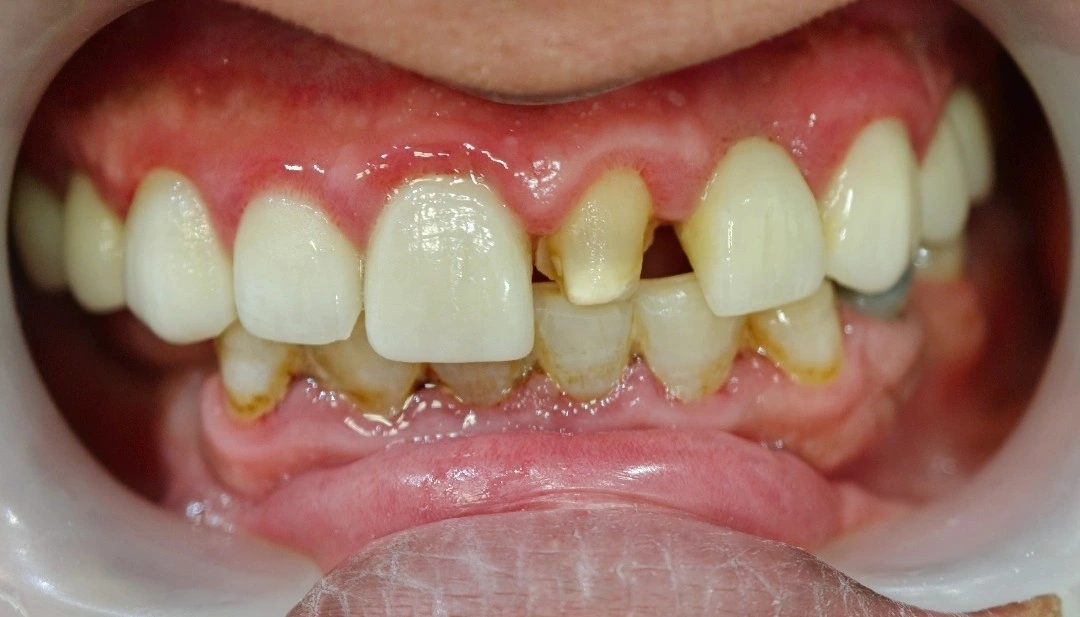
The patient only wanted me to «stick her debonded veneer back on», but the real problem was not the quality of the previous dentist's cement; it was the principles that had been ignored.
Presenting Complaint. The patient presented complaining that the veneer on her upper left central incisor, placed elsewhere, kept falling off. She was unhappy with her own dentist's skill in bonding veneers and, believing the problem was merely a matter of «knowing how to stick it on», asked me to cement this veneer for her at whatever cost it took.
Evaluation. The clinical condition of the tooth and of the masticatory system was severely compromised. Several gross and fundamental errors were apparent:
- No posterior support: the patient has no posterior support, which in itself places a doubled load on the anterior teeth.
- Severe gingival inflammation: with inflammation at this level, achieving proper isolation in order to cement bonded restorations — whose prognosis is tied directly to bond quality — is all but impossible.
- Over-prep: a very extensive preparation has been carried out on the tooth and we are fully into dentin. The repeated debonding shows that the previous colleague did not observe the technique-sensitive protocols for bonding to dentin.
- Residual caries: obvious caries is still visible on the prepared tooth.
- Retained previous cement: in situations like this, the inner surface of the veneer is usually not cleaned properly of the previous resin cement, and without absolute cleanliness no bond takes place.
Decision and Treatment Plan. The patient's request to re-cement the veneer was firmly declined. I never bond someone else's restoration: for a trivial cementation fee, the entire responsibility and every risk of work that is wrong from the foundation up transfers to me, and at the first failure the patient holds the second dentist to blame.
The patient's alternative request — root canal treatment of the tooth and a crown — was declined as well. The reason was plain: with no posterior support, in the presence of periodontal problems, and with the serious esthetic challenge of matching a single-unit crown to the veneers on the adjacent teeth (for a patient carrying a false satisfaction with her previous treatment), this treatment too was doomed to fail.
️Clinical Tip: cementing another colleague's restoration is not a favour to the patient; it is accepting responsibility for every one of their biomechanical errors (such as the absent posterior support), their incorrect preparation and their periodontal problems. Successful bonding requires an isolated environment, free of inflammation and caries. A foundation that is ruined from the base cannot be rescued by a good cement.
The content of this page is intended for the educational use of dentists and dental students.