
Chairside 40
Why Didn’t I Permanently Cement All the Crowns, and Why Did I Use Different Cements?
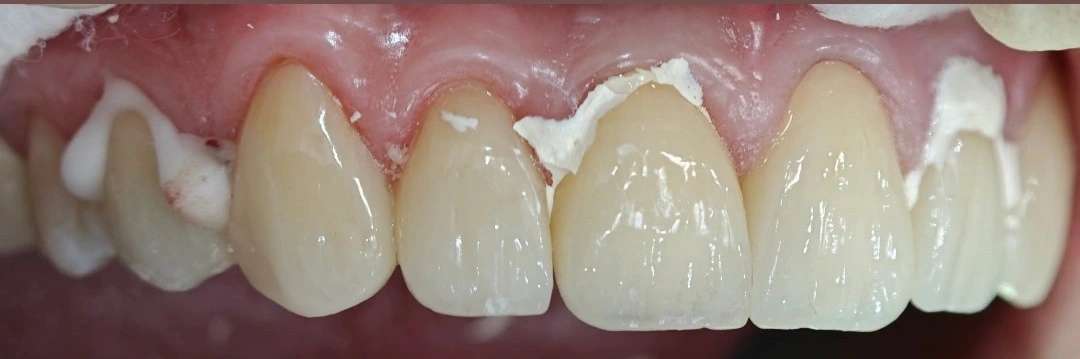
A patient for whom I had previously placed a combination of crowns and veneers came in for permanent cementation of the crowns. The crowns on both maxillary central incisors, the maxillary left lateral incisor, and the maxillary right first premolar had been cemented temporarily. The patient was happy with the appearance and shade of the teeth, and the plan was now to cement the crowns permanently.
I removed the crowns, but the maxillary left central incisor crown did not come off with gentle tapping. In this situation, I do not increase the force of the tapping; I did not want to accept the risk of damaging the tooth or fracturing the crown just to remove it. So this crown remained in place for the time being.
That also changed my decision for the contralateral central incisor.
The maxillary right central incisor crown had been removed, and I could have cemented it permanently. But the maxillary left central incisor crown was still in place with temporary cement. I did not want to create a potential shade difference between the two by changing the cement beneath only one central incisor crown, especially when the patient was happy with the current appearance.
So I recemented the maxillary right central incisor crown with temporary cement. I preferred to keep the cementation conditions of the two central incisor crowns the same until I could remove and clean both crowns and cement them with similar cement.
For the maxillary left lateral incisor, maintaining harmony with the adjacent restorations mattered.
This crown was next to the two central incisor crowns and the other veneers. My aim was to preserve the accepted appearance of the anterior region as much as possible when changing from temporary to permanent cement. In this case, I selected zinc phosphate because its shade and opacity were similar to those of the temporary cement I had used, to reduce the chance of changing the crown’s appearance.
For the maxillary right first premolar, which did not carry the same esthetic sensitivity as the anterior region in this patient, I used glass ionomer cement.
Ultimately, both central incisor crowns remained temporarily cemented, the maxillary left lateral incisor crown was cemented with zinc phosphate, and the maxillary right first premolar crown was cemented with glass ionomer.
The patient had come in for permanent cementation, but the final decision for each crown depended on the condition of that tooth and its relationship with the adjacent restorations. The patient’s satisfaction with the current appearance was part of the decision, an outcome I wanted to preserve as treatment continued.
The content of this page is intended for the educational use of dentists and dental students.