
Chairside 54
When the patient's wishes do not align with the right treatment
A patient had been referred for treatment planning of the maxillary anterior teeth. According to the history, there had previously been swelling in the area of the maxillary right lateral incisor (tooth 2), which had resolved by the time of the visit. On radiographic examination, in addition to problems with the root canal treatments, there was evidence of caries beneath the crowns.
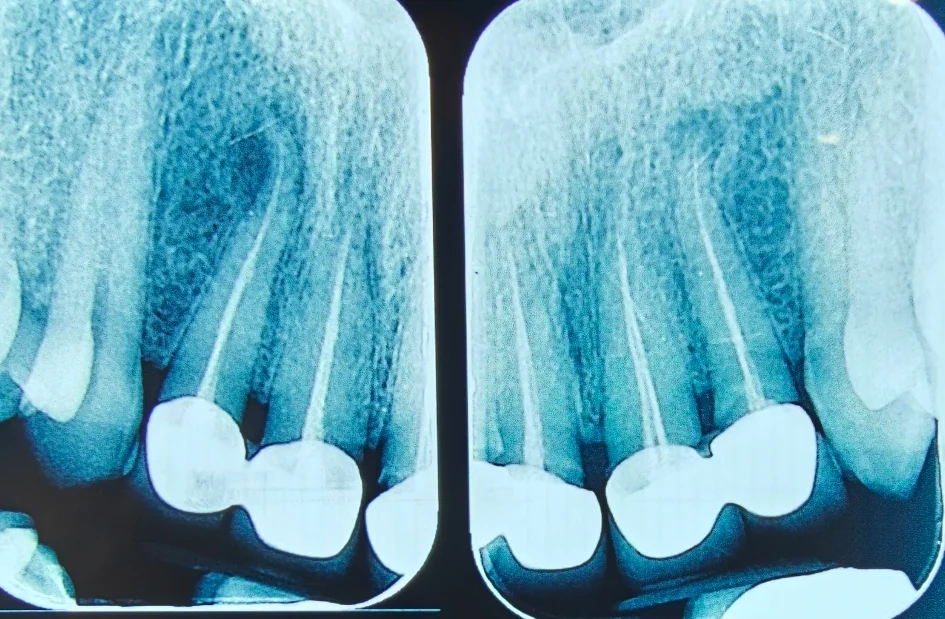
My recommendation was to remove all the crowns first, assess the condition of the teeth and the amount of sound tooth structure remaining, and only then decide on root canal retreatment and prosthetic reconstruction.
However, the patient was reluctant to have the crowns removed. They said these were anterior teeth and that having the crowns taken off would be difficult for them. Their question was whether the root canal retreatment could not be done through the existing crowns.
Root canal retreatment through a crown is possible in some situations, but this patient's problem was not only the root canal treatment. When an endodontically treated tooth has a periapical lesion, we need to ask where the infection came from and why the previous treatment failed. One important possibility is microbial leakage from the coronal side of the tooth (coronal leakage).
If the cause of the problem is caries or leakage beneath the crown, retreatment through the crown may control the infection inside the canal, but the source of the leakage remains and there is a possibility of recontamination. In this patient, the evidence of caries beneath the crowns made this issue all the more important.
Another issue was determining the prognosis of the teeth. For example, for the maxillary left lateral incisor (tooth 2), until the crown is removed and the extent of tooth destruction is known, it is not even possible to say with confidence whether the tooth can be kept and restored.
So in this case, removing the crowns was not merely a preliminary step toward making new crowns; it was an essential part of diagnosis and treatment planning.
The point I want to emphasize is that the patient's wishes must certainly be taken into account in our decision-making, but that does not mean we always treat according to them. Sometimes accepting a patient's request in order to make treatment simpler means ignoring a problem that should have been addressed from the start. In such situations, going along with the patient's wishes may lead to incomplete treatment and ultimately to the patient's own detriment.
This page is intended for educational use by dentists and dental students.