
DentAI – Combination Syndrome: Taught for Fifty Years, Then Not Found
فارسیCombination syndrome has been taught in lecture halls for fifty years and is used to justify heavy preventive treatment. One study went looking for it in 99 patients with exactly that jaw configuration, to see whether the picture actually shows up in the clinic.
Every one of us heard this as a student: a patient whose maxilla is completely edentulous, facing only the remaining mandibular anterior teeth, is headed for a specific fate. It was called combination syndrome, and it had five components that were supposed to arrive together: bone resorption in the anterior maxilla, enlargement of the tuberosities, papillary hyperplasia of the hard palate, extrusion of the lower anterior teeth, and bone resorption under the denture bases in the posterior mandible. Six further signs were added to the list later which, apart from the periodontal changes, were effectively the signs of an old prosthesis and inadequate care.
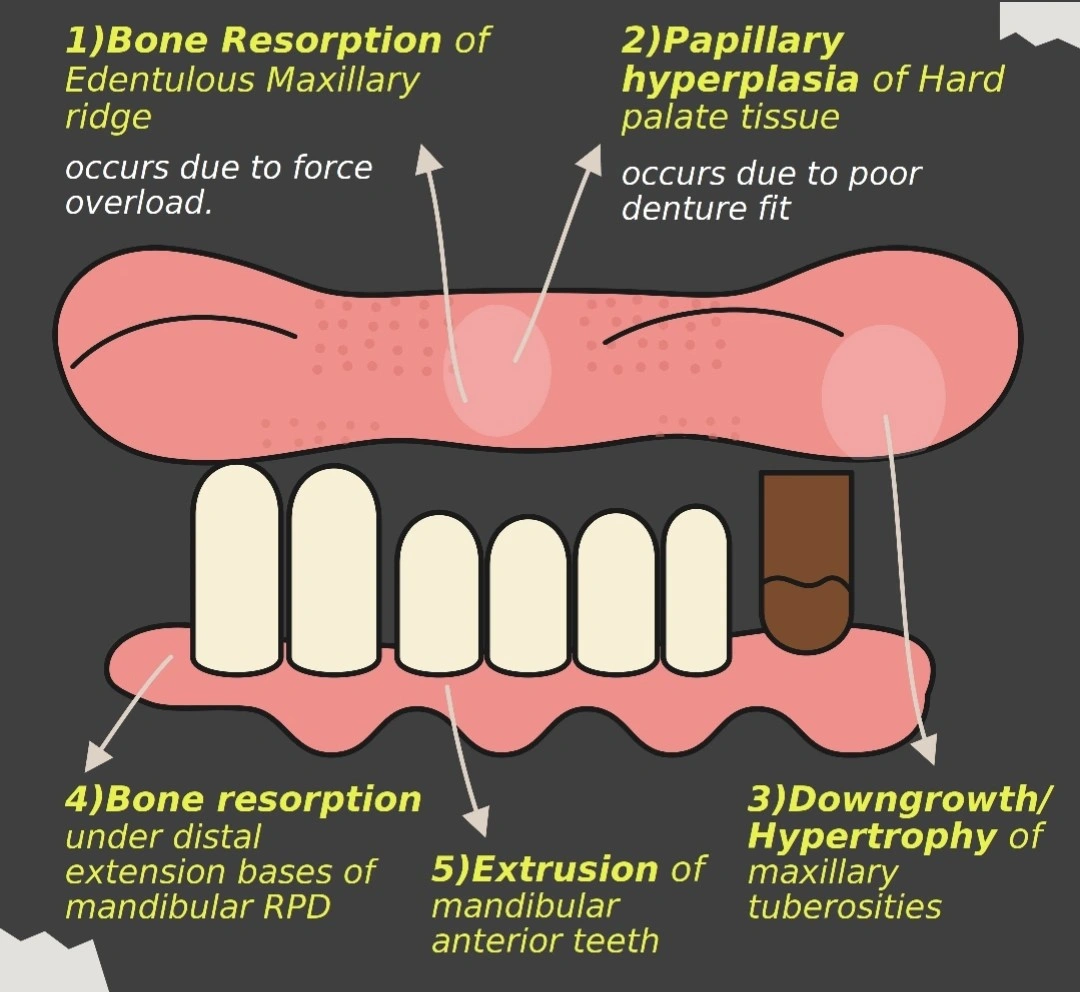
This building was put up on a very narrow foundation. Kelly, in 1972, had followed only six patients. The later studies that confirmed the syndrome's existence had around 75 patients between them. That was enough for material on this syndrome to enter the textbooks and for treatments to prevent it to be taught all over the world: from implants and precision attachments through to more complex techniques. Treatments that are often multidisciplinary, take time, and carry a considerable cost. In 2003 a critical review of the literature concluded that the phenomenon does not even meet the requirements for being called a "syndrome" in medicine, and yet effectively nothing in the teaching changed.
Until, in 2019, three researchers at King's College London decided to go looking for it directly. Ninety-nine patients with a maxillary complete denture opposing only mandibular anterior teeth, all examined by a single examiner. The subtle point of the design was that these patients had come from a referral hospital, meaning difficult cases and previously unsuccessful treatments. If the syndrome was going to be found anywhere, it was here.
It was not found.
No patient had more than two signs. Extrusion of the lower anterior teeth, perhaps the most intuitive component of the whole picture, was seen in nobody. Papillary hyperplasia in two people, and tuberosity enlargement in two people. Bilateral resorption of the posterior mandible in no case at all. And more interesting still, a considerable number of patients had less resorption in the posterior mandible than in the corresponding maxillary regions, that is, exactly the opposite of what the hypothesis predicted.
But one thing was found, and it was very common indeed. Thirty-eight of the 99 patients had severe resorption of the anterior maxillary sextant, and in every one of those cases the resorption was accompanied by fibrous replacement. The same flabby ridge all of us wrestle with when taking an impression.
So why do the other components not come along with it? The authors' logic is clear. Papillary hyperplasia is a product of the denture biofilm, not of trauma from occlusion. Loss of vertical dimension (VD), epulis fissuratum, and poor prosthesis adaptation are likewise the signs of a neglected prosthesis, not parts of a syndrome. The things that were seen together were together because in a patient with an old prosthesis all of them are likely, not because they share a common root.
The study had a second question as well: does a lower partial denture do these patients any good. The answer was interesting. The partial denture offered no protection against the anterior maxillary ridge becoming flabby; the trend in the data even ran the other way. But it had two real effects: patients who had a partial rated both the retention of their upper denture and their own chewing ability more highly, while the prevalence of periodontitis among them was higher. So the lower partial denture has its place, on the grounds of function and patient satisfaction, with its periodontal cost accepted.
The conclusion that comes out of this paper is simple, and it is worth changing behaviour for. Kelly's five-component picture is not seen in clinical reality; it is either rare or it does not exist at all. But the anterior maxillary problem is entirely real and is present in close to 40 percent of these patients. So our energy should go there, and not to the heavy preventive treatments whose prescription the paper's own authors treat as a question mark in the absence of conclusive evidence.
The problem is real, but it is not a syndrome.
Primary source:
Bagga R, Robb ND, Fenlon MR. An investigation into the prevalence of combination syndrome. J Dent. 2019;82:66-70.
"An investigation into the prevalence of combination syndrome"
Rita Bagga, Robb ND, Fenlon MR — J Dent. 2019;82:66-70
DOI: 10.1016/j.jdent.2019.01.016