
One-Piece or Two-Piece Implant: Which Performs Better After 15 Years?
In choosing an implant, we usually look at the amount of bone loss and at implant survival. The main question of this article is whether an implant with less bone loss is more beneficial for the patient in the long term or not.
What is the difference between the two systems?
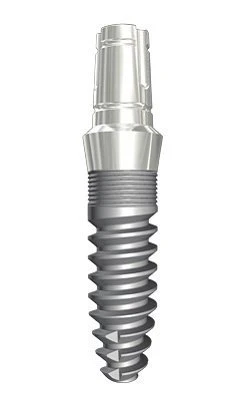
In a one-piece implant, the fixture and the abutment are a single piece, so there is no connection or microgap between them. In a two-piece implant, the abutment is separate and is attached to the fixture. The idea of the one-piece supporters is that without this connection, bone stays more stable.
How was the study done?
This study is the continuation of a randomized trial at the University of Zurich. Sixty patients with 151 implants entered the study. The one-piece group was treated with Straumann and the two-piece group with Brånemark. After 15 to 17 years, 39 patients with 95 implants came for examination.
How was survival?
In terms of survival, no serious difference was seen. Overall survival was 95%: 91.8% for the one-piece and 98% for the two-piece. In total only 5 implants were lost (4 one-piece and 1 two-piece), and the reason for all of them was peri-implant disease. The numbers are so small that the authors did not make a statistical comparison, so we cannot say that one of the two has better survival.
What happened to the marginal bone?
At the final follow-up, the marginal bone level in the one-piece implants had stayed almost stable (0.08 mm) and in the two-piece implants it had dropped somewhat more (1.53 mm). The authors consider this an advantage of the one-piece system. But no statistical test is reported for this comparison, and the numbers belong only to implants that were still in the mouth at the end. The two systems also differed in design and surface, so we cannot attribute the whole difference to being one-piece or two-piece.
How was the tissue around the implant?
More inflammation was recorded in the one-piece group. BOP (bleeding on probing) was higher, and mucositis was seen in 71% of the one-piece implants versus 34% of the two-piece. Even so, about half of the mucositis cases resolved during follow-up. Peri-implantitis overall was 13.3%: 12 of 65 one-piece implants and 8 of 86 two-piece implants. The number of cases was too small for a firm conclusion. Not having a connection does not reduce the risk of inflammation and peri-implantitis to zero.
How many prosthetic complications were there?
This is where the two groups differ most. Twenty-three of 65 one-piece implants (35.4%) had a technical complication, versus 5 of 86 two-piece implants (5.8%). Of the 40 complications recorded, 34 belonged to the one-piece group:
- Matrix and ball attachment replacement in removable prostheses: 12
- Screw loosening: 10
- Chipping: 7
- Loss of the screw access hole restoration: 4
- Debonding: 1
(Note: in a one-piece implant there is no separate abutment, so the screw that loosens is the prosthesis's own screw. The article does not specify the type of screw.)
In the two-piece group only 6 complications were seen. No fracture of the implant, screw, abutment or framework was reported. The type of prosthesis was not the same in the two groups, so we cannot put the whole difference on the implant design alone.
Limitations
The two-piece system in this study is Brånemark, an older generation of two-piece implants. The result cannot be generalized to today's systems with internal connections and platform switching. About 35% of the patients were also absent at the final follow-up.
Summary
The one-piece system in this study preserved bone better, but it had more technical complications. So when choosing a system, preserving bone is not enough. The type of prosthesis, the possibility of repair, and the cost and time that maintenance takes over the years must also be part of the decision.