
Vertical Platform Discrepancy of Adjacent Implants and Bone Loss: Should We Splint the Crowns or Make Them Independent?
When we place several implants next to each other, we usually pay more attention to the horizontal distance between them and try to respect the minimum 3 mm rule. This rule was formed on the basis of implants whose platforms were at roughly the same level. In practice, however, because of an uneven ridge or a difference in placement depth, the platforms may not be at the same level, and one of them may sit lower than the other.
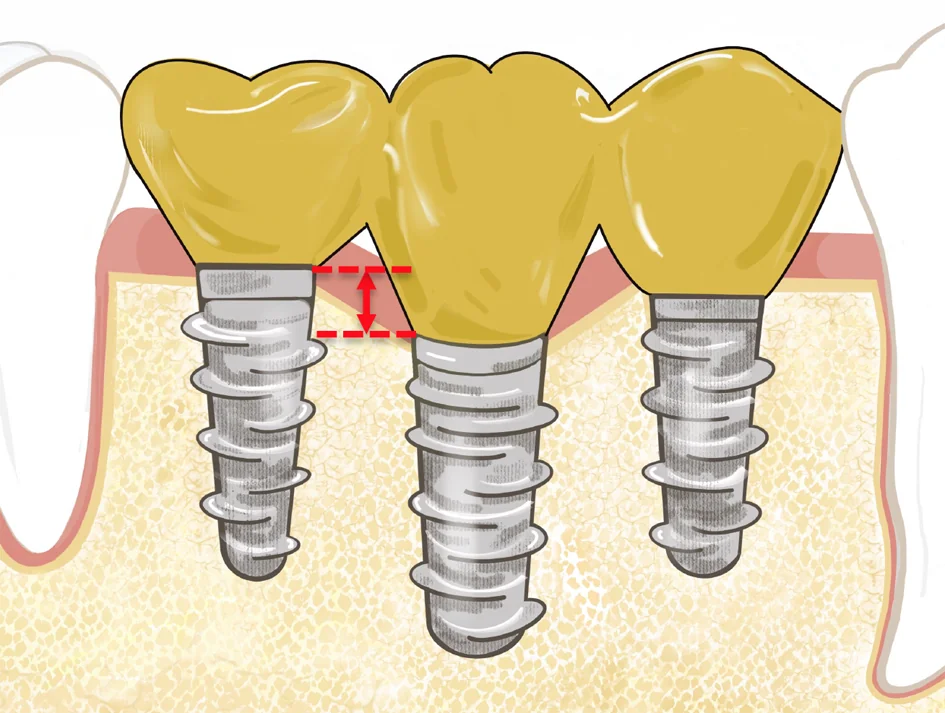
This difference is called Vertical Platform Discrepancy or Vertical Level Discrepancy. The main question is what effect this vertical difference has on the marginal bone, and what role it plays in our decision to splint the crowns.
Where did this discussion start?
Dr. Vahid Khoshkam studied this topic in his thesis at USC. His preliminary report was published in 2017, that is, several years before the first full article on this subject was printed.
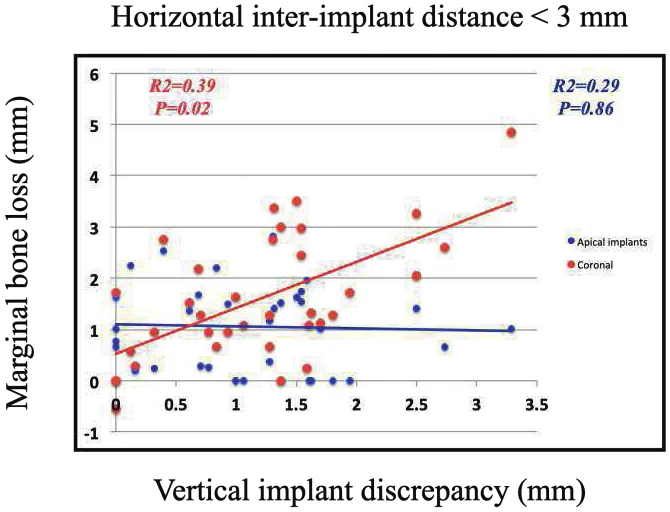
In the preliminary analysis he found no significant association. But in a later report with a larger sample (an abstract), a clear pattern emerged. When the horizontal distance between two implants was 3 mm or less, the implant whose platform was more coronal showed more bone loss. If the height difference was also more than one millimeter, the bone loss around the coronal implant was about twice that of the apical implant (about 2 versus 1 mm, according to the figures of that report). This association was not seen at a horizontal distance of more than 3 mm.
What role does splinting play?
In 2023, Lin and colleagues went one step further and examined the type of restoration in addition to the height difference. The figures in this section are from that article and show the situation up to the time of its publication.
Effect of height difference: When the platforms of adjacent implants had a height difference of at least 0.5 mm, the odds that at least one of the implants had 1 mm or more of bone loss were about four times those when the platforms were roughly at the same level.
Effect of splinting: Splinting the crowns had a similar effect. The odds of this amount of bone loss in splinted crowns were about 2.5 times those of independent crowns.
Combination of the two factors: When these two factors came together, the difference became more striking. In about 60 to 67 percent of patients whose implant platforms had a height difference and whose crowns were splinted, at least one of the implants showed 1 mm or more of bone loss. This figure was about 20 to 25 percent in patients with independent crowns.
Three-unit bridge: A three-unit bridge on two implants showed a different pattern. This bridge also connects the two implants, but its results were similar to independent crowns.
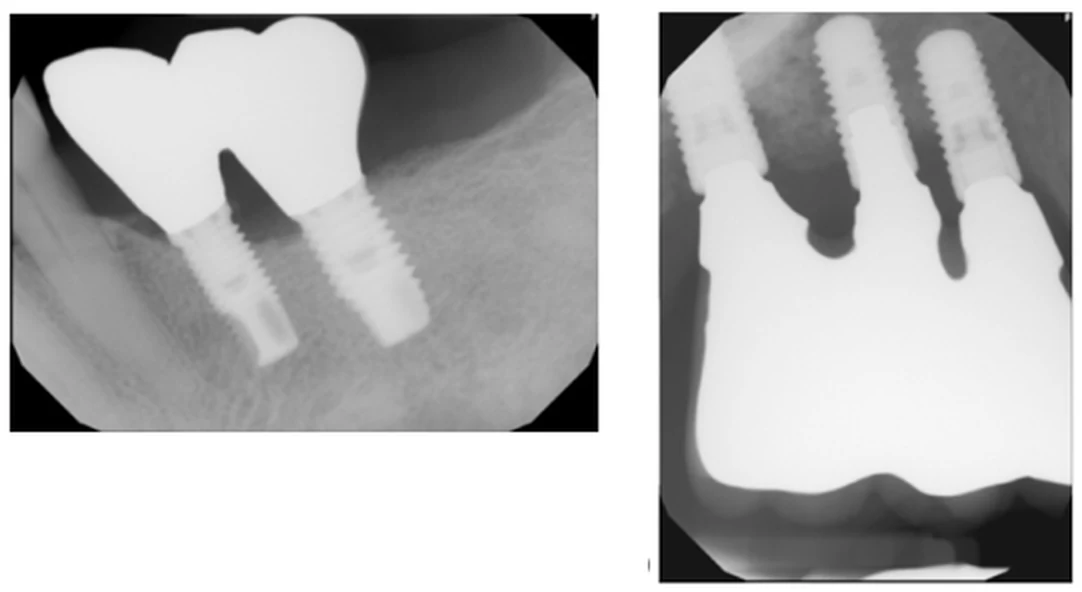
Location of bone loss: In splinted crowns, bone loss occurred more at the more coronal implant, and the bone level sometimes dropped to about the height of the platform of the more apical implant. This pattern was not seen in independent crowns or bridges. The authors also reported that in some patients this bone loss had occurred even with a horizontal distance of more than 3 mm.
Why is bone lost?
The first explanation relates to hygiene access. When the platforms are at two different heights, the area between the implants becomes deep and irregular. If the crowns are also connected and the emergence profile is designed bulky or too convex, the patient practically cannot clean this area. As a result, plaque may accumulate in this area and the tissue around the implant may become inflamed. The different behavior of the bridge is also consistent with this explanation, because the pontic area in a bridge leaves more space for cleaning.
The second explanation is mechanical. Each crown on its own has some misfit at the crown–abutment connection and at the abutment–implant connection. When several crowns become a single structure, these misfits add up and transfer more stress to the implants and the bone around them.
Ceddia and colleagues, in 2025, showed with a finite element study that the vertical arrangement of three splinted implants changes the distribution of stress in the bone. However, the greatest stress in their model was seen around the deeper implant, while in patients bone loss has occurred at the more coronal implant. So this simplified model does not explain the clinical pattern, and direct transfer of its results to the clinic may be limited.
What should we do in the clinic?
The authors of the Lin study suggest that when the platforms have a height difference, the crowns be made independent. That said, splinting is not a bad choice in itself. A systematic review (de Souza Batista and colleagues, 2019, abstract) showed that, in general, splinted and independent crowns do not differ in terms of bone loss and prosthetic complications, and implant survival is slightly higher in the splinted condition. Lin and colleagues explain that this review probably found no difference in bone loss because it did not examine the height difference of the platforms, and part of its studies were on short implants. So the main problem is not the splint itself, but its combination with the height difference of the platforms.
So when we face implants placed at two different heights, we should first examine whether splinting is really mechanically necessary or whether independent crowns are enough.
If splinting is needed, we should design the space between the implants so that the patient can clean it, and not make the emergence profile of this area bulky for no reason. Making a provisional prosthesis in these cases is a good opportunity to assess tissue health and the possibility of keeping hygiene before making the final prosthesis. Then we can repeat in the final prosthesis the contour that worked in the provisional.
It is better to consider the possible height difference of the platforms in the treatment plan before surgery, in addition to the horizontal distance. It is still not clear whether the presence of a height difference needs a horizontal distance of more than 3 mm or not.
How much can we rely on this evidence?
The Lin study is retrospective, and the researchers have not been able to assess factors such as oral hygiene and occlusion in it. So these findings show an association, not a cause-and-effect relationship. The 0.5 mm figure has also been used for statistical categorization and should not be taken as an allowable limit or a risk threshold.
Conclusion
An appropriate horizontal distance alone is not enough to preserve the bone between implants, and the vertical position of the platforms also matters. The current evidence suggests that the greatest risk is when a height difference of the platforms is combined with splinted crowns. It seems that hygiene access and the summation of misfits in an integrated structure play the main role in this.
For this reason, when a height difference exists, an independent crown is a reasonable first choice. If splinting is needed, the prosthesis design must allow the patient to keep the area between the implants clean.