
RPD Framework: Is 3D-Printed Metal Really Better Than Casting?
Imagine an RPD framework arrives from the laboratory, but at the try-in it does not seat completely. The rest does not sit well in its place, the proximal plate has a gap, or the clasps need adjustment.
Now the question is: if we had made this same framework by 3D metal printing instead of conventional casting, would these problems have been fewer?
To answer, we need to separate three fabrication methods.
In the conventional method, the framework is made by the lost-wax casting technique. This method has a long history and acceptable results, but the many steps of pattern making, investing and casting can be sources of error.
In the hybrid or partial digital workflow, the design or the pattern is digitized, but the metal is still produced by casting.
In the third method, the framework is built directly from metal powder, layer by layer. Technologies such as selective laser melting (SLM) and direct metal laser sintering (DMLS) belong to this group.
Of course, metal printing does not mean every step is digital; the initial data may come from an intraoral scan or from a scan of a stone cast.
But which method is more accurate?
To answer, we have to distinguish between fabrication accuracy and clinical fit.
Trueness shows how close the fabricated piece is to the original reference, and precision shows how similar the results of repeating a process are to one another.
But these two concepts are not necessarily equivalent to a good fit. Fit mostly concerns the relationship of the framework with hard surfaces such as the abutment tooth, whereas adaptation is usually used for the relationship of the prosthesis with soft tissue.
So greater measurement accuracy, by itself, does not prove that the framework seats better in the mouth.
In 2026, Alqutaibi et al., in a systematic review, examined 30 studies on metal partial denture frameworks.
The results showed that, under many conditions, printed frameworks are comparable to conventional casting in accuracy and fit, and sometimes perform better.
But the results were not uniform. In some studies, the conventional or partial digital method was more accurate, and even among printed frameworks, certain areas such as the rests, guide plates and minor connectors showed more error.
This difference matters, because an error does not have the same consequence in every part of the framework. For example, a gap at the rest seat may affect seating and force transfer, whereas an error at the end of the clasp may affect retention. Of course, merely measuring a gap does not prove a functional disturbance.
On the other hand, print orientation, layer thickness, supports and post-processing steps also affect accuracy. So the quality of all SLM frameworks is not necessarily the same.
But what does the clinical evidence say?
In 2025, Elgamal et al. carried out a study on 24 patients with a mandibular Kennedy Class I. For each patient, two cobalt-chromium frameworks were made.
In the first method, a conventional impression was taken and the stone cast was scanned with a laboratory scanner. In the second method, the data were recorded directly with an intraoral scanner.
Both frameworks were made by SLM. So the study did not compare casting with metal printing; it examined two methods of recording data within the same fabrication process.
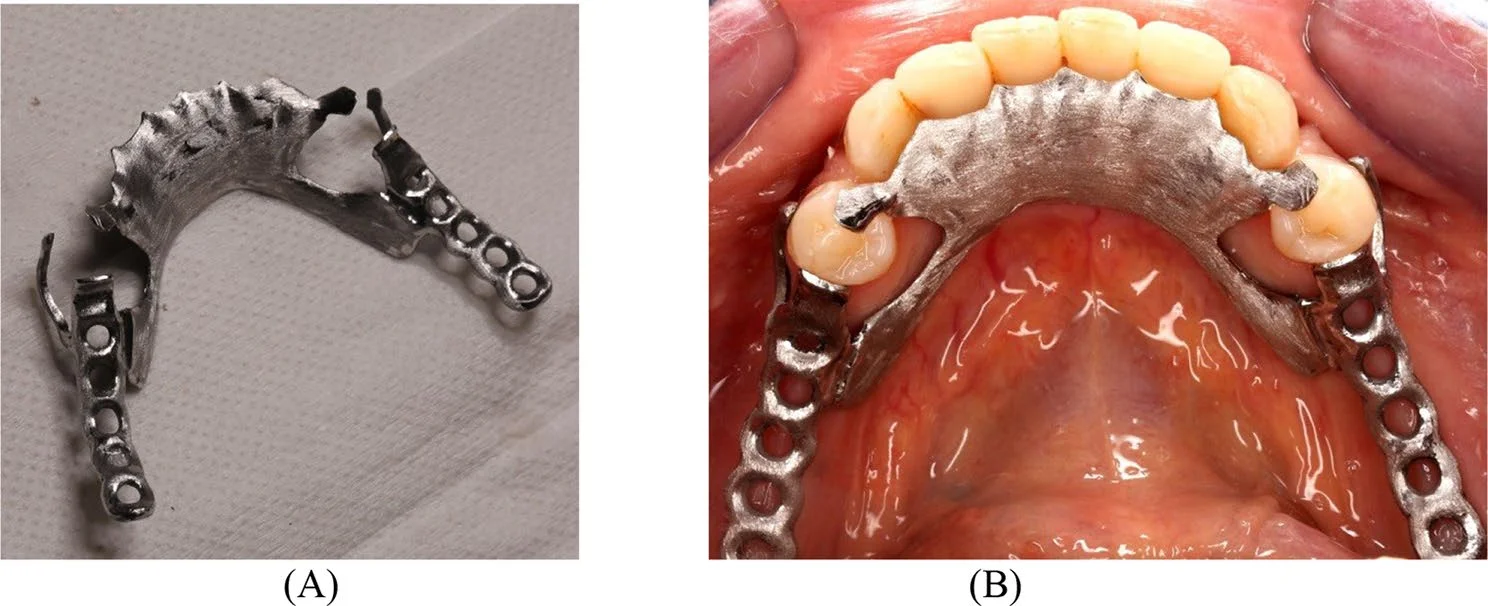
By superimposing the scan files, the researchers measured the distance of the framework at the rest, proximal plate, lingual plate and the terminal of the I-bar clasp.
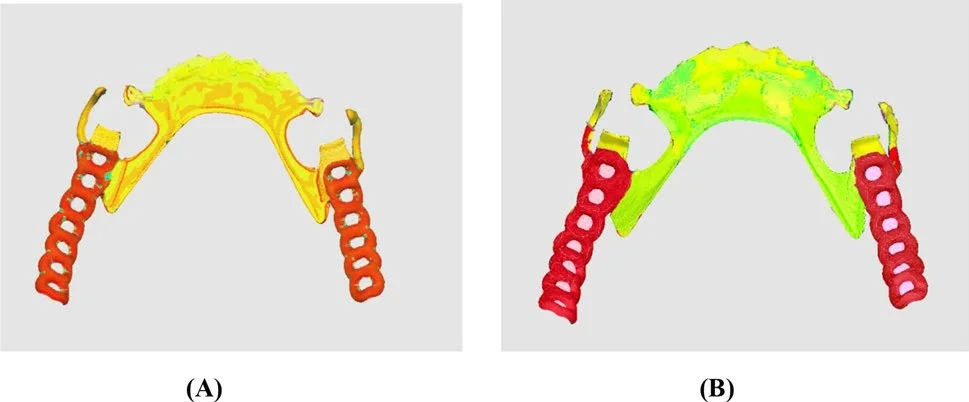
The fully digital workflow was more accurate in all these areas, and the differences were statistically significant.
But the mean difference between the two methods was only about eleven microns.
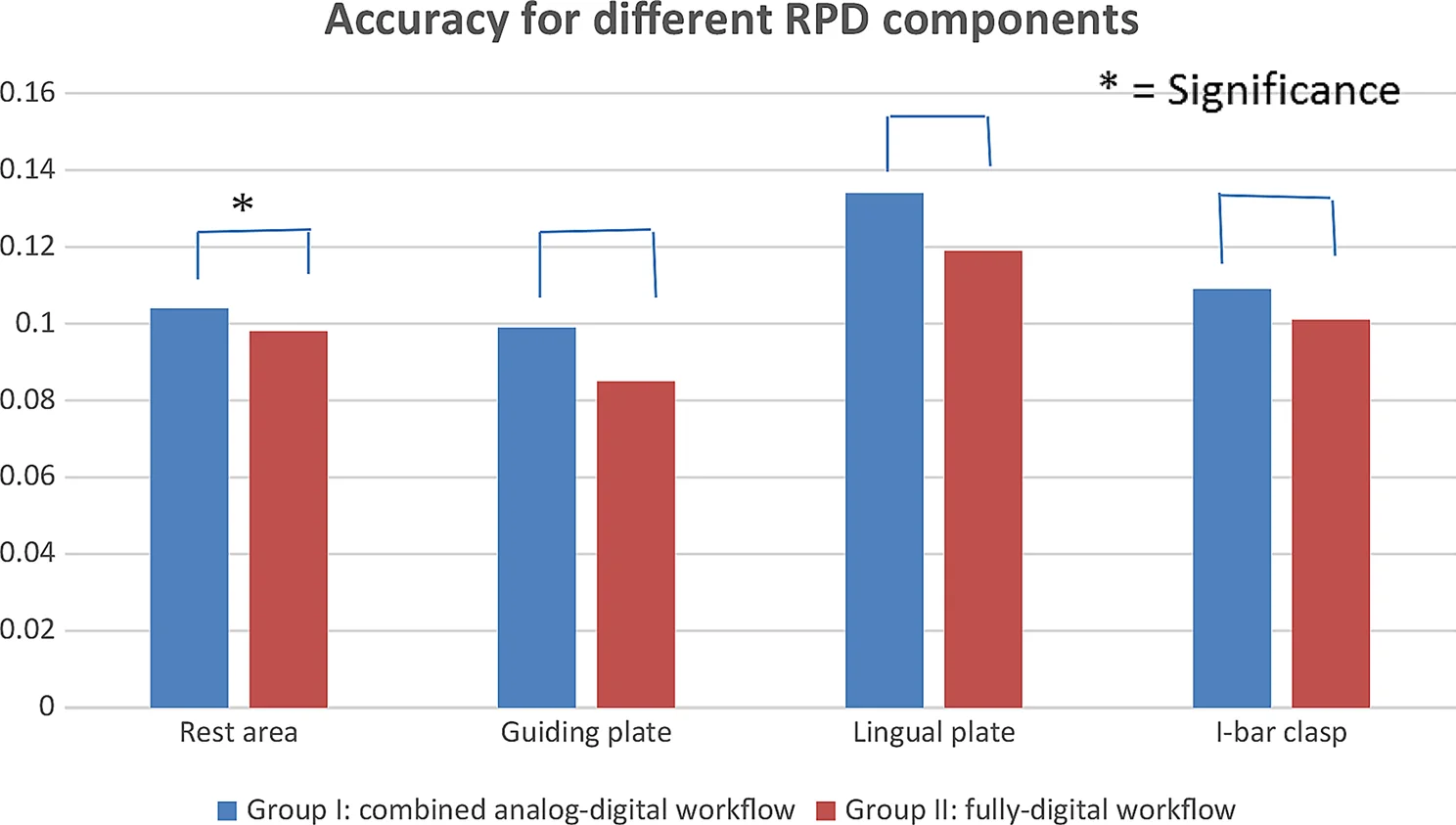
The authors themselves stressed that this difference, despite its statistical significance, has no clinical importance, and that both methods were clinically acceptable.
This is exactly the important difference between statistical superiority and therapeutic benefit. The study showed that the fully digital workflow is more accurate, but it did not prove that this small difference improves the treatment outcome.
The more practical point of this study lies elsewhere. Both frameworks were made with the same method, so the difference probably came from the data-recording step. The authors regard this step as the weakest link of the combined workflow, because errors of impression taking, pouring the stone and scanning the cast add up. That is, if we are looking for a more accurate framework, the quality of the impression or scan matters as much as the fabrication method.
Now, if fabrication accuracy is not always better, what about mechanical properties?
The Alqutaibi systematic review showed that in some studies, SLM frameworks were better than cast samples in yield strength, hardness and some other mechanical properties. Their microstructure was also sometimes finer and more uniform.
But greater surface roughness and internal porosity were among the raised concerns, and some studies also showed no important difference in fatigue resistance.
This matters especially for clasps. In the clinic, initial strength is not the only thing that counts; maintaining retention, resistance to deformation and long-term durability matter too.
For now, we do not have enough evidence to say that printed frameworks are necessarily more durable.
In some clinical studies, patient satisfaction with frameworks made by laser technology, especially in comfort, stability and cleaning of the prosthesis, was higher. But the number of these studies is limited, and most of the systematic review's evidence comes from laboratory studies.
So what conclusion do we draw for clinical decision-making?
3D metal printing is no longer merely an experimental technology. With it, one can make frameworks with acceptable accuracy and performance that are sometimes equal to or even better than the conventional method. But we still do not have enough evidence to consider conventional casting obsolete.
The quality of the initial data, the framework design, control of the fabrication process and the experience of the laboratory all play a role in the result.
More importantly, being digital does not remove the need for a clinical try-in. The seating of the rests, the relationship of the proximal plates, the state of the connectors, the retention of the clasps and possible pressure on the tissues must still be checked.
Digital technology has changed the way the framework is made, but it has not yet been shown that this change necessarily leads to greater clinical success or longer durability.
3D metal printing is a valuable fabrication method, not a guarantee of a better framework.